Denti.AI: Voice-Enabled Charting, Perio, and the AI Scribe


Most of the dental AI you’ll hear about lives on the X-ray screen. It’s a set of eyes — it looks at a bitewing and draws a box around a cavity. We’ve written about plenty of those: Overjet, Pearl, VideaHealth and Diagnocat. Denti.AI does that too — but it’s better understood as something else: an extra pair of hands and a voice. Its headline trick isn’t reading your film. It’s doing the paperwork of the whole visit while people just talk.

So what is Denti.AI, exactly?
It’s a bundle rather than a single gadget. Under one roof you get voice-driven gum charting, an AI scribe that writes the clinical note, automatic charting of your existing fillings and crowns, an X-ray reader, and even an AI receptionist that answers the phones. You don’t have to buy all of it — but the reason the company gets talked about is that it stitches the boring, click-heavy parts of a dental visit together and hands them to software.
The everyday version, from a patient’s chair: fewer people hunched over a keyboard, and the hygienist’s hands staying where they belong — in your mouth, not on a mouse.
Voice Perio: charting a gum exam without lifting a finger
This is the part real hygienists rave about, so it’s worth explaining. A periodontal exam is the one where someone gently pokes the gum around each tooth and reads off a stream of numbers — pocket depths, bleeding points, recession, mobility, and so on. Traditionally it’s a two-person job: one person probes and calls out numbers, another types them in. Or one exhausted person does both, badly.
Denti.AI’s Voice Perio replaces the typist with speech recognition trained on dental jargon. The hygienist just says the readings out loud and the chart fills itself in, live. The company says a full perio chart can be done solo in under five minutes, and points to more than a million charts completed and around 99% voice accuracy even in a noisy operatory. That last bit matters — a general-purpose voice assistant falls apart when a suction is running and someone’s saying “four, four, five, bleeding on the distal.” This one is tuned for exactly that.
The AI scribe: it writes the note while you talk
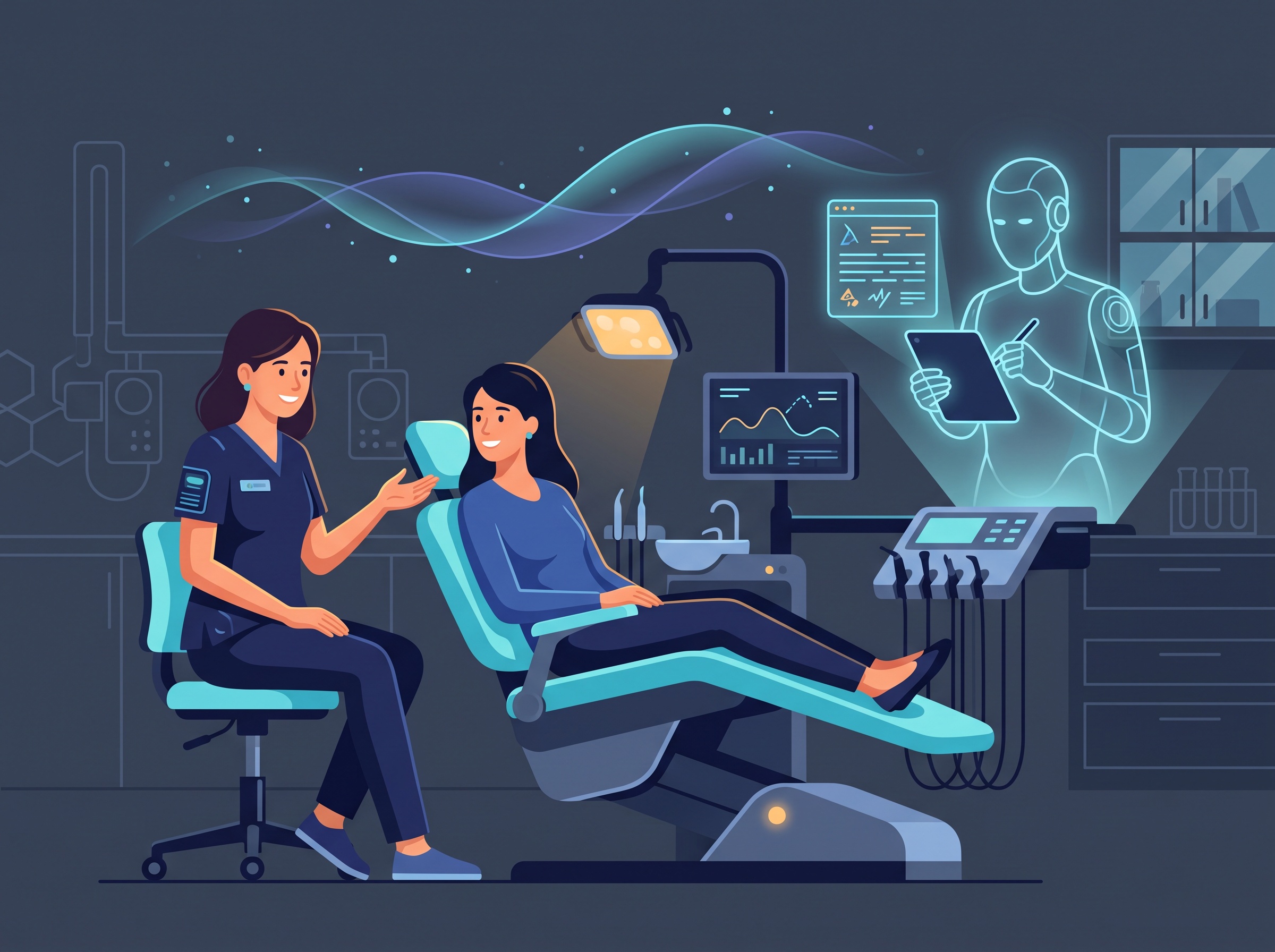
The second big piece is the AI scribe. During your appointment it listens to the conversation between you and the dentist and turns it into a structured clinical note — the chief complaint, what was examined, the diagnosis, the plan. It can tell voices apart (dentist, hygienist, assistant, patient) and, per the company, handle 50-plus languages.
If you’ve ever noticed your dentist trailing off mid-sentence to peck at a computer, this is the fix. The note gets drafted in the background; the clinician reviews and signs off instead of building it from scratch after hours. It’s the same idea sweeping through human medicine right now — the “ambient scribe” — pointed at the dental chair.
And yes, it reads your X-rays too
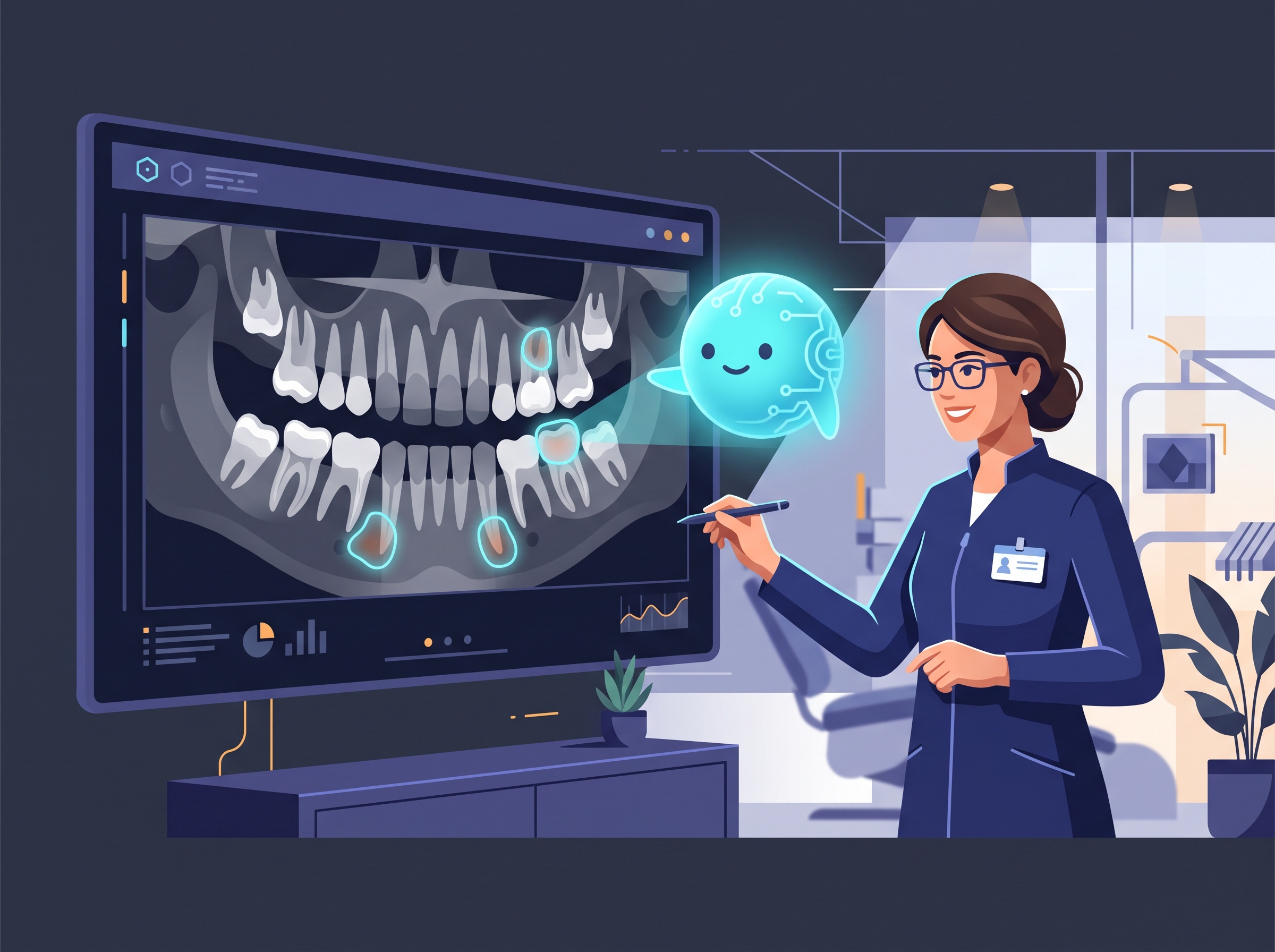
The imaging side is where Denti.AI earns its regulatory stripes. Its detection models are FDA-cleared, and the company’s notable claim is clearance for disease detection across both panoramic and intraoral radiographs — covering the three findings dentists care about most: caries (cavities), periapical radiolucencies (dark spots at the root tip that hint at infection), and bone levels. On the screen it works like the others: suspected problems get highlighted right on the image as a visual second opinion.
One thing that turns heads: pricing. Denti.AI has positioned its X-ray AI at around $49 a month, well under what the big imaging platforms have historically charged. For a small practice on the fence, that’s often the difference between “maybe next year” and “let’s try it.”
How it plugs into the practice
Here’s the practical detail, because it’s the one that decides whether a tool actually gets used. Denti.AI writes into the software the office already runs. The company lists direct integration with essentially every major practice-management system — Dentrix and Dentrix Ascend, Eaglesoft, Open Dental, Denticon, CareStack, ClearDent, ABELDent, Curve Dental, Oryx and more — and the voice charting can dictate into more or less anything that accepts text input.
That’s a meaningful design choice. Unlike a pure imaging tool that mostly needs a copy of your X-ray, Denti.AI’s value lives at the charting layer — it has to write measurements and notes back into your permanent record. So it sits on top of the practice-management system rather than beside it. For patients that’s invisible; for a practice deciding what to buy, it’s the whole ballgame, because a tool that can’t write into your chart just makes more work.
What it means for you in the chair
Strip away the feature list and Denti.AI is really about attention. The voice charting and the scribe exist to keep humans looking at you instead of a keyboard, and to get the tedious documentation done in the room instead of dragging appointments out. The X-ray AI adds the familiar second-set-of-eyes safety net on top.
Is it magic? No — and Denti.AI is refreshingly upfront that the AI assists and the clinician decides. A voice chart still needs a hygienist who knows what they’re probing; a drafted note still needs a dentist to read and own it. But of all the dental AI we’ve covered, this is the one most aimed at the part of the visit patients quietly hate — the endless typing. If you want the wider map of who does what, our field guide to AI in dentistry lays it all out. The short version for Denti.AI: it’s not trying to be the smartest eyes in the room. It’s trying to give everyone in the room their hands, and their attention, back.

Sources & further reading:
- Denti.AI — Dental AI Scribe, Voice Perio, AI Receptionist & Imaging
- Denti.AI Voice Perio — hands-free periodontal charting
- Denti.AI PMS Integrations — works with your dental software
- Dental AI: The Complete Guide for Practices (Denti.AI)
Related Reading
- DentalMonitoring: AI That Follows Ortho Cases From Home
- The State of AI in Dentistry 2026: A Field Guide to the Tools
- VideaHealth: The AI That Charts Your Teeth Automatically