Diagnocat: Cloud AI for 2D X-rays and 3D CBCT

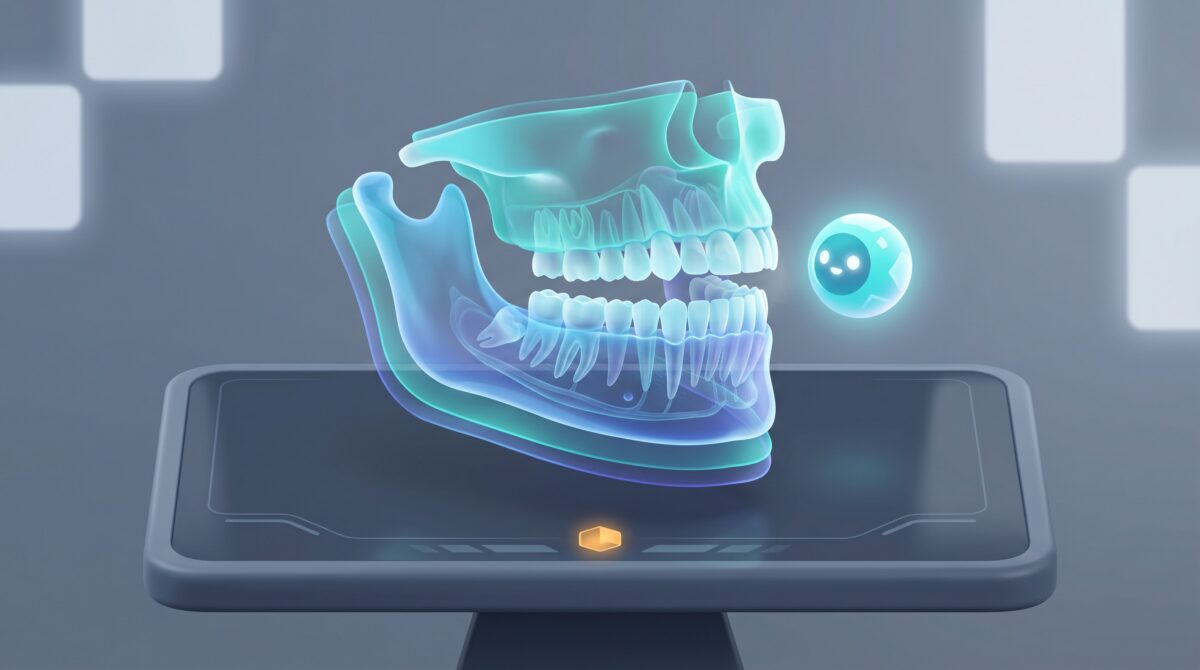
Most of the dental AI you’ll run into reads a flat picture. You know the type — a bitewing X-ray pops up on the screen, and the software draws a little box around a suspicious spot. Useful stuff. But teeth aren’t flat, and neither are jaws. That’s where Diagnocat is different: it doesn’t just read the 2D X-rays, it reads the full 3D scan of your jaw — and then writes up what it found like a radiologist would.
If you’ve read our explainers on Overjet, Pearl, or VideaHealth, you already know the 2D side of this story. Diagnocat is the one that goes into the third dimension. Here’s what it actually does, and how much to trust it.
What Diagnocat Actually Does
Diagnocat is a cloud-based AI that analyzes dental images and hands back a structured report. It works on the everyday 2D shots — bitewings, periapicals (single-tooth close-ups), and panoramic X-rays — but its real party trick is CBCT. That stands for cone-beam computed tomography, which is the dental version of a CT scan: instead of one flat picture, it captures a full 3D volume of your teeth, roots, jawbone, sinuses, and nerve canals.
Feed Diagnocat one of those scans and it goes to work automatically. It picks out each tooth, flags findings across dozens of categories — cavities, bone loss, suspected infections around root tips, impacted wisdom teeth, and more — and even segments the anatomy into clean 3D models. Think of it as a very thorough, very fast reader that never gets tired halfway through a complicated scan.
Why 3D Is a Bigger Deal Than It Sounds
A flat X-ray squashes everything into one plane. Two roots can hide behind each other; a small problem near the sinus or the nerve canal can be tough to see. A CBCT scan doesn’t have that problem — but it comes with the opposite one: there’s so much data that a busy dentist can miss something simply because there’s a lot to scroll through.
That’s the gap Diagnocat is built for. It combs through the whole volume so nothing gets skipped, then surfaces the handful of things worth a closer look. For the kinds of cases where 3D matters most — implant planning, root canals, wisdom-tooth extractions, orthodontics — that extra set of eyes is genuinely handy.
How It Gets Your Scan
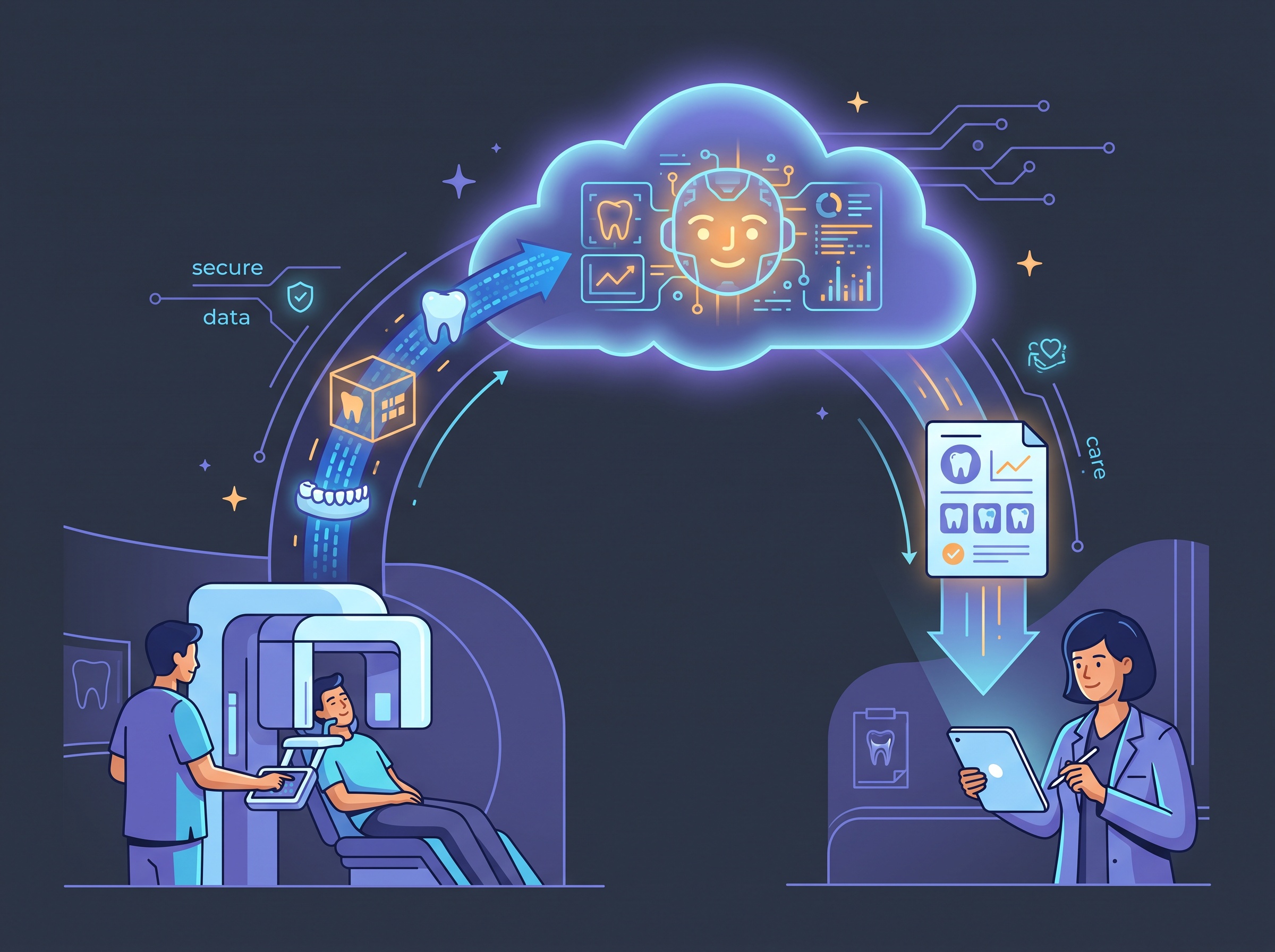
Here’s the part that makes Diagnocat tick, and the part that matters if you’re wondering where your data goes: it lives in the cloud. Your clinic’s scanner captures the image, and the software uploads it to Diagnocat’s servers, where the AI does its analysis and sends back a report — usually within minutes.
It’s designed to play nicely with the CBCT machines dental offices already own, including big names like Sirona, Vatech, Planmeca, and Carestream. Because the heavy lifting happens in the cloud, a practice doesn’t need a monster computer under the front desk to run it. The flip side is that your images travel off-site, which is why the security piece (more on that below) isn’t just fine print.
It Doubles as a Filing Cabinet
One underrated thing about Diagnocat: it isn’t only a diagnostic tool, it’s also a home for your records. Each patient gets a cloud file that can hold their 2D X-rays, 3D scans, clinical photos, 3D-printable models (STL files, the kind used for aligners and surgical guides), and documents — all in one place.
For you as a patient, that mostly means your dentist can pull up everything in one spot and, when needed, share a clean report with a specialist. If you’ve ever been handed a CD of your X-rays to carry to an oral surgeon, you’ll appreciate why this is an upgrade.
Is It FDA-Cleared? And Is It Safe With Your Data?
This one deserves an honest answer. Diagnocat has been used by dental professionals in more than 50 countries for years, but for a long time it wasn’t cleared for clinical use inside the United States. That changed recently: the company announced U.S. availability with FDA clearance for its CBCT visualization tool, bringing it into American clinics on the same regulatory footing as its 2D competitors. If you’re outside the U.S., it’s been part of the dental-AI landscape for a while already.
On the data side, Diagnocat says it’s HIPAA and SOC 2 compliant, with end-to-end encryption in transit and at rest. That matters more here than with on-site software, precisely because your scans leave the building. It’s a fair question to ask your dentist — any good practice will have an answer.
What It Means for You (and the Catch)
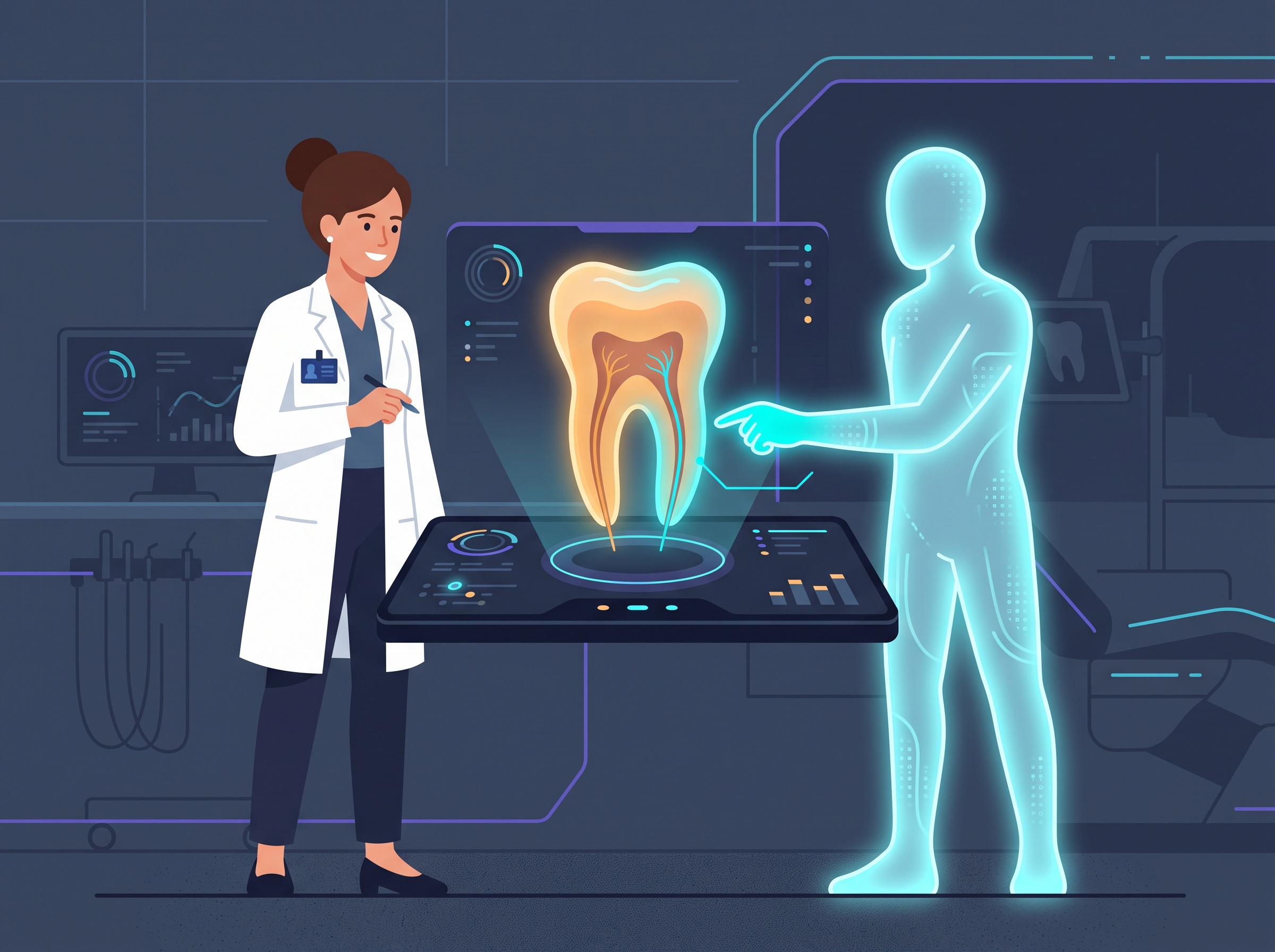
Here’s the honest bottom line: Diagnocat is a second opinion, not a verdict. Independent studies have tested how well AI like this spots findings on panoramic and CBCT images, and the results are encouraging but not flawless — these systems can miss things and can flag things that turn out to be nothing. That’s exactly why they’re built to assist a dentist, not replace one.
So if your dentist mentions running your scan through Diagnocat, take it as a good sign: it means an extra, tireless reviewer looked at your 3D images before anyone made a decision about your teeth. The AI raises its hand; your dentist still makes the call. For a fuller picture of where tools like this fit, our field guide to AI in dentistry maps out the whole landscape.

The real story of dental AI isn’t that a robot is diagnosing you — it’s that your dentist quietly picked up a superpower. Diagnocat is one of the clearest examples: it takes the most complex images in the practice, the ones with the most places for something to hide, and makes sure a second set of eyes has seen every corner. That’s not AI taking over the chair. That’s AI making the person in it a little bit better at their job.
Sources & further reading:
- Diagnocat — FDA-cleared, HIPAA and SOC 2 compliant CBCT visualization
- Diagnocat US launch announcement
- Detection accuracy of an AI platform for dental treatment features on panoramic radiographs (Scientific Reports, 2025)
Related Reading
- The State of AI in Dentistry 2026: A Field Guide to the Tools
- Pearl Second Opinion: Chairside AI That Reads Your X-rays
- VideaHealth: The AI That Charts Your Teeth Automatically