Overjet, Explained: What Dental AI’s Insurance-and-Imaging Platform Actually Does

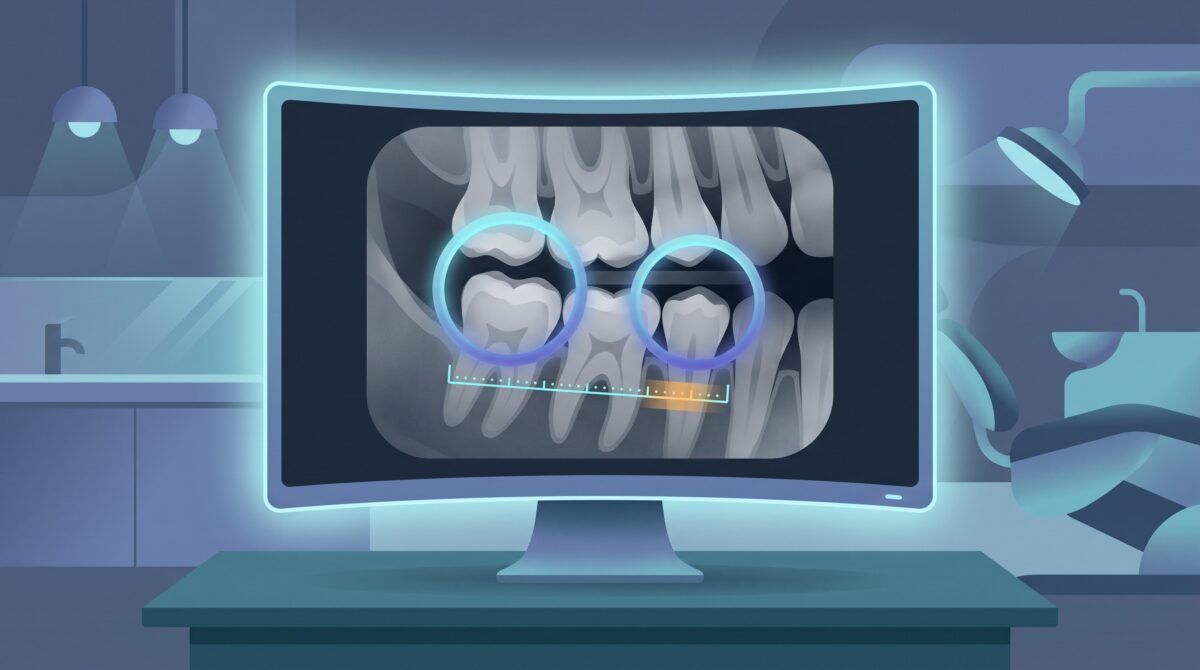
You have probably heard of AI that writes emails and AI that generates images. You have almost certainly not heard of Overjet. And yet, if you have had a set of X-rays taken in the last couple of years at a reasonably modern dental office, there is a decent chance Overjet’s software has already looked at your teeth. It is one of the biggest names in dental AI, and it does something quietly clever: it reads dental radiographs, and it also lives inside the insurance company. That combination makes it worth understanding.
This piece is part of our field guide to AI in dentistry, where we walk through the tools one at a time. Overjet is a good place to start, because it shows up on both sides of your dental visit — the chair and the bill.
So what is Overjet, in one sentence?
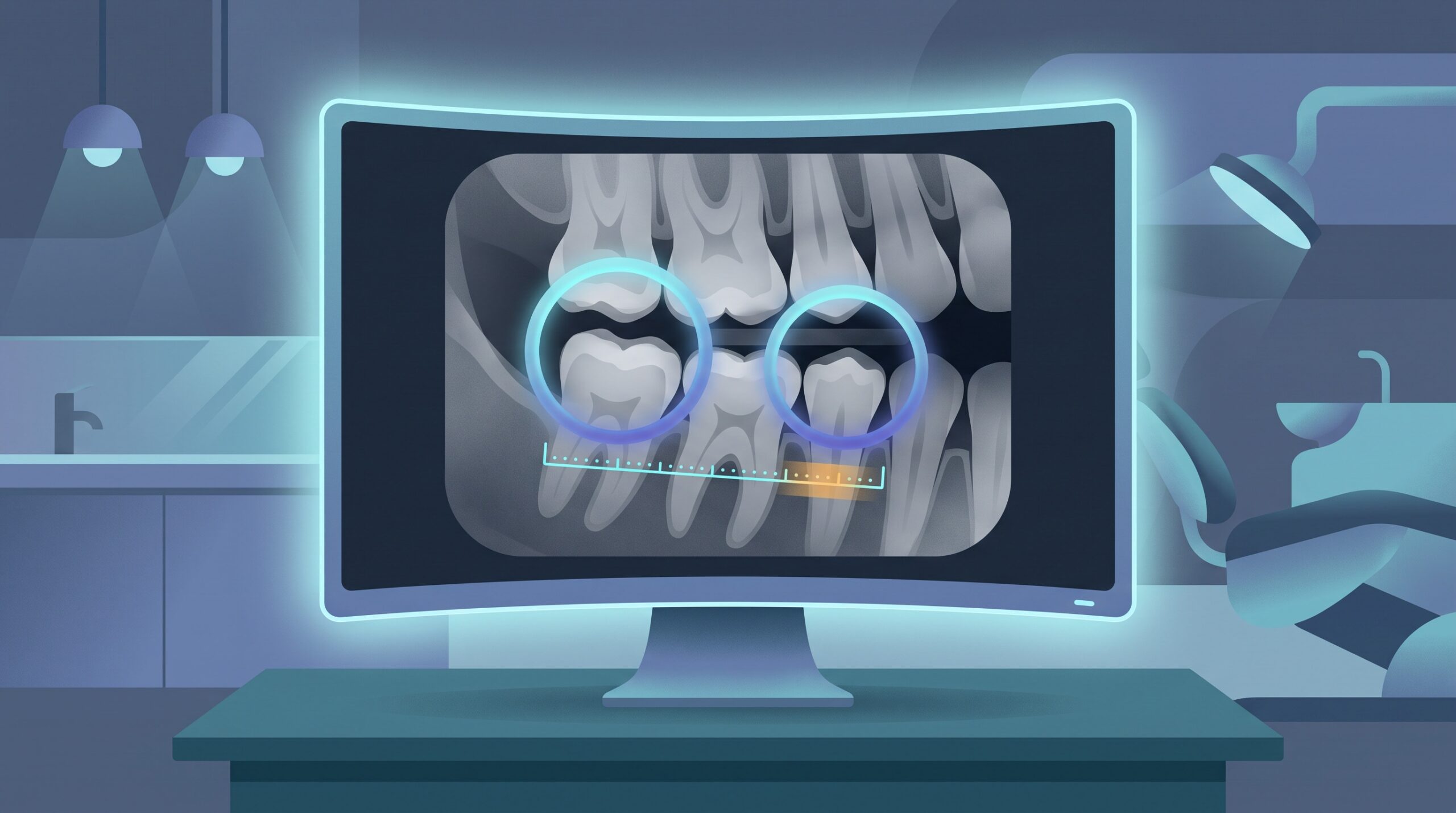
Overjet is a Boston-based company that makes AI software for reading dental X-rays. Point it at a bitewing or a periapical radiograph and it draws colored outlines over what it finds — suspected cavities, calculus (hardened tartar), and bone loss around the teeth — and it measures things, like how far the bone has receded, in actual millimeters. Think of it as a very consistent second set of eyes that never gets tired at the end of a long clinic day.
The key word is assistive. Overjet does not diagnose you and it does not treat you. It highlights and quantifies; your dentist looks at those highlights, agrees or disagrees, and makes the actual call. That distinction matters, and we will come back to it.
The unusual part: it works for the dentist AND the insurer
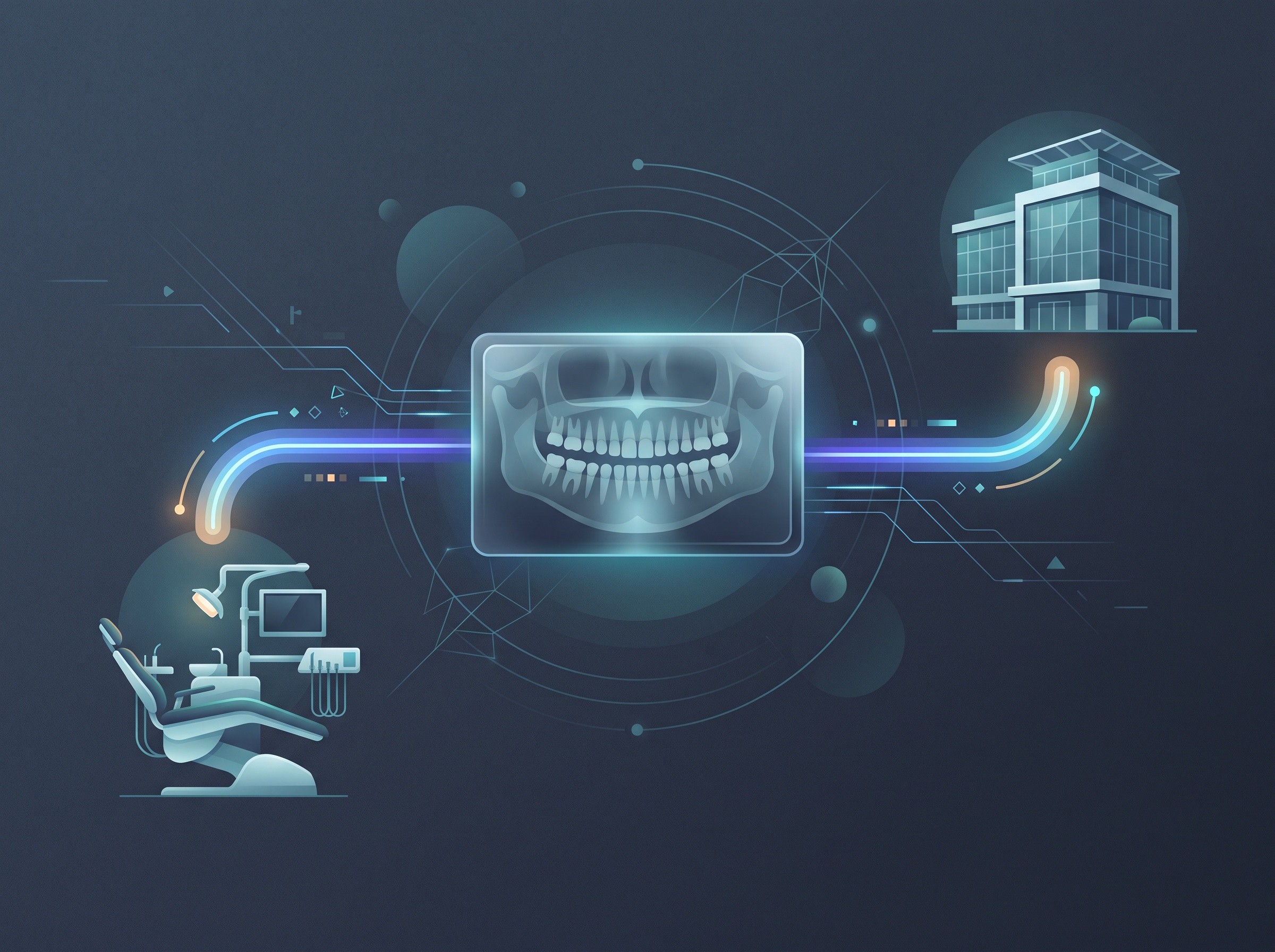
Most dental AI tools sell to dental practices. Overjet does that too, but it also sells to dental insurance companies — the payers. Insurers use the same underlying image-reading technology to review the X-rays that come attached to claims, checking whether the pictures support the treatment being billed.
This is genuinely different from most AI you interact with, and it cuts both ways. For a dentist, having the insurer read images with the same objective yardstick can mean fewer arbitrary claim denials and faster approvals, because the bone loss is measured, not argued about. For a skeptic, it is fair to ask what it means when the same company’s model sits on both sides of the table. Either way, the dual role is why Overjet is such a big deal in the industry — it is woven into the money side of dentistry, not just the clinical side.
Is it actually FDA cleared, or is that marketing?
It is real regulatory clearance, not a marketing flourish. Overjet holds multiple FDA 510(k) clearances for its detection software — the first of them, for measuring bone levels to help assess periodontal disease, cleared back in 2021 (filing K210187), with additional clearances following for caries detection, including its Caries Assist module cleared in 2025. Independent reviews of the field consistently list Overjet as one of the most heavily cleared players in dental imaging AI.
What FDA 510(k) clearance means in plain terms: the software has been reviewed as a medical device and shown to perform comparably to an accepted standard for its specific, narrow job. It does not mean the software is infallible or that it replaces a clinician’s judgment. It means the tool is allowed to be used as an aid, within defined limits. That is the honest ceiling of what any of these clearances promise.
How does it even get your X-ray?
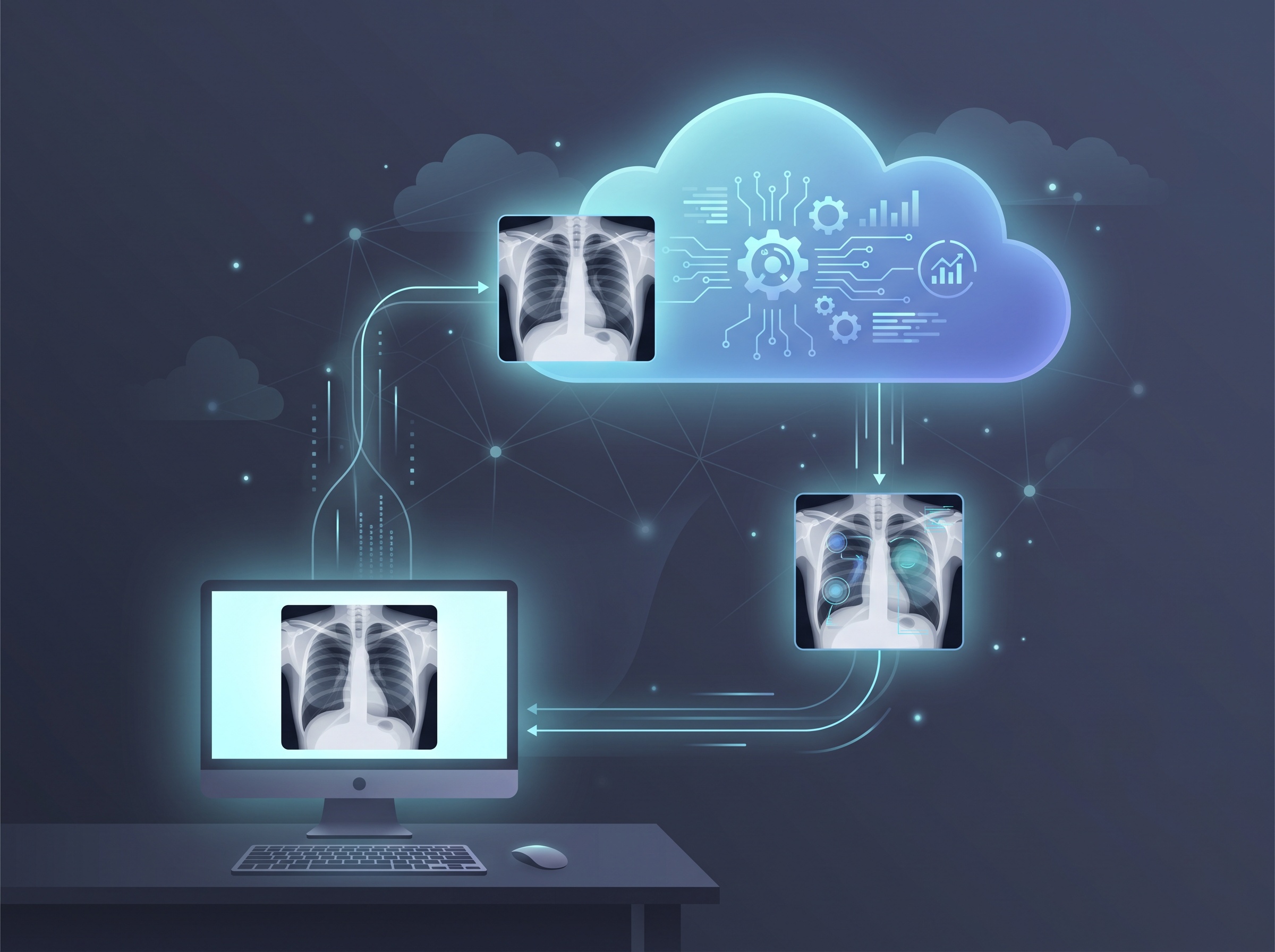
This is the part patients never see, and it is the reason tools like Overjet spread so fast. Overjet does not ask your dentist to buy new X-ray hardware or re-photograph anything. It connects to the imaging and practice-management software the office already runs, pulls the radiographs that were captured normally, and analyzes them in the cloud. The annotated version comes back and appears alongside the original image.
Because the analysis happens in Overjet’s cloud rather than on the office computer, your radiographs — which are protected health information — leave the practice to be processed. That is standard for cloud dental AI, and it is exactly why the boring questions of data governance and vendor agreements matter so much on the practice side. As a patient, the thing to know is simply that this is cloud software, not a magic box in the corner of the room.
What it actually changes for you in the chair
Two things, mostly. The first is detection. A small interproximal cavity between two back teeth is easy to miss on a grainy X-ray at a glance; an AI that flags it can prompt a closer look. Studies from Overjet and others suggest AI-assisted reading catches findings that unaided reads sometimes miss — though it can also flag things that turn out to be nothing, which is why a human still filters the results.
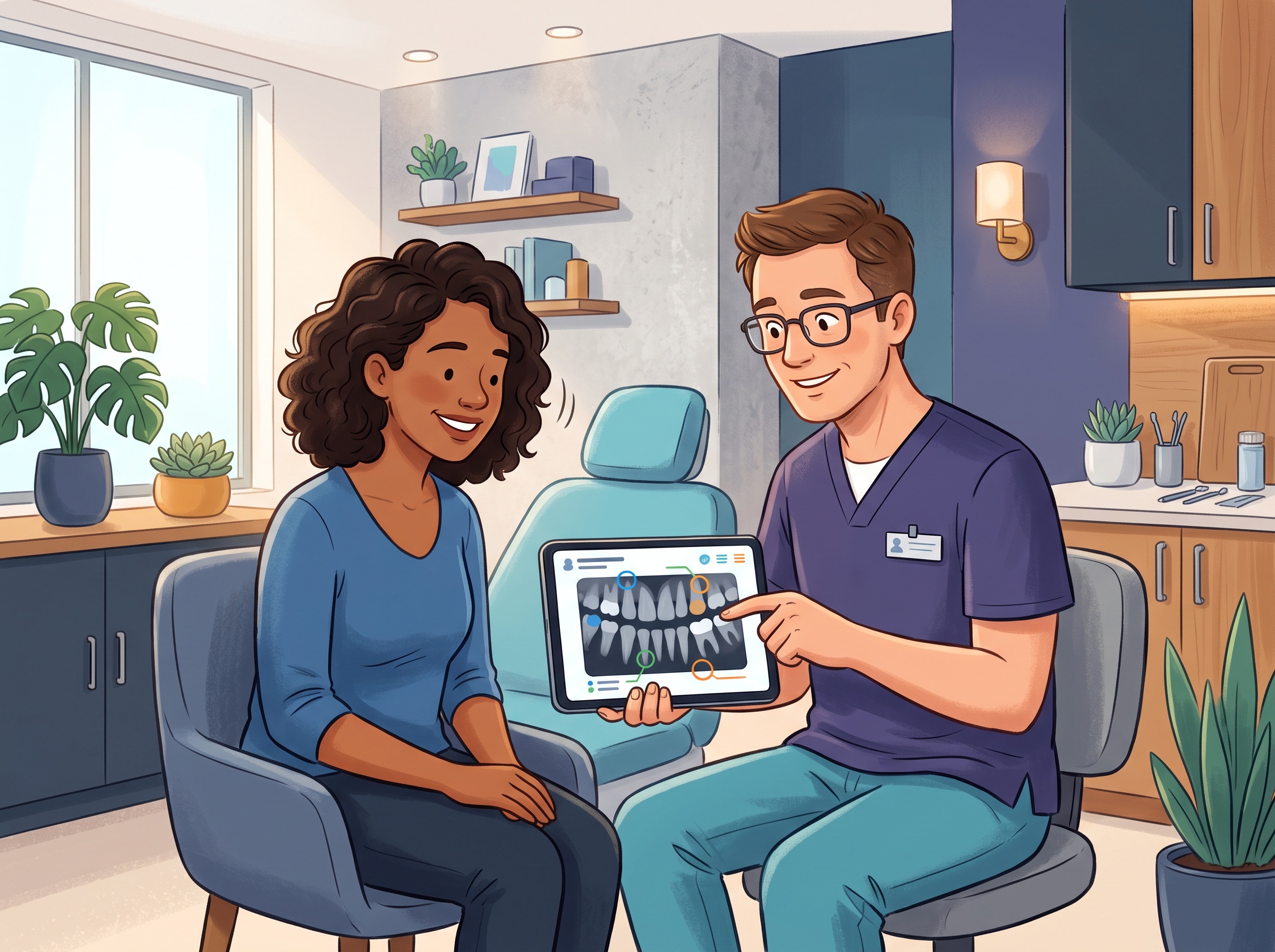
The second is communication, and honestly it might be the bigger deal. When a dentist says “you have a cavity here,” it can feel like you are being upsold. When a colored outline is sitting right on top of the tooth on the screen and the bone loss is labeled in millimeters, it becomes a lot easier to see what they are talking about. Patients tend to trust — and accept — treatment they can actually see. That is not manipulation; a real finding is a real finding. It just turns an abstract claim into a picture.
The limits worth keeping in mind
Overjet is powerful within a narrow lane and unremarkable outside it. It reads 2D radiographs for a defined set of findings; it is not a general “is this patient healthy” oracle, and it does not examine your gums, bite, or soft tissue the way a clinician does. It can be wrong in both directions — missing something or flagging a shadow that is not disease — which is precisely why it is cleared as an aid and not an autopilot. And its answers are only as good as the X-ray it was handed; a poorly angled or underexposed image gives the AI the same bad information it gives the human.
None of that is a knock. It is the correct way to read every tool in this series: brilliant at one specific task, dependent on a person to own the decision. Overjet’s real significance is not that it will one day replace your dentist — it will not — but that it has quietly become part of the plumbing of modern dentistry, sitting between the X-ray sensor and the insurance claim, measuring the things that used to be a matter of opinion.
The best AI tools do not make humans obsolete; they make the invisible visible and let a professional act on it faster and more consistently. Overjet is a textbook example — and once you know it is there, you will understand your next dental visit a little better than the person in the chair beside you.
Sources & further reading:
- Overjet Receives Second FDA Clearance, Adding Overjet Caries Assist — Overjet
- FDA-Approved AI Solutions in Dental Imaging: A Narrative Review — PMC
- How Accurate is Dental AI in Detecting Dental Pathologies — Overjet
Related Reading
- The State of AI in Dentistry 2026: A Field Guide to the Tools
- Pearl Second Opinion: Chairside AI That Reads Your X-rays
- DentalMonitoring: AI That Follows Ortho Cases From Home