DentalMonitoring: AI That Follows Ortho Cases From Home


Almost every dental AI we’ve written about lives on the X-ray screen inside the office. It’s a smart set of eyes pointed at a film the dentist already took — Overjet, Pearl, VideaHealth, Diagnocat. DentalMonitoring is the odd one out, and deliberately so. It doesn’t read your radiographs at all. It watches your braces or aligners move between visits — using photos you take of your own mouth, on your own phone, from your own couch.

What DentalMonitoring actually is
DentalMonitoring is a remote-monitoring platform for orthodontics. The idea is simple to say and clever to pull off: instead of driving to the office every few weeks so an orthodontist can glance at your teeth and say “looking good, see you next month,” you take a quick scan at home on a schedule — usually weekly — and an AI checks your progress. If everything’s on track, nobody needs to see you. If something’s off, the system flags it and your orthodontist reaches out.
The company has been at this longer than most, and it shows in the numbers it cites: models trained on more than 500 million photographs, tracking well over 100 orthodontic conditions. It works for both fixed braces and clear aligners, and it’s used by orthodontists and general dentists running aligner cases.
The ScanBox: turning your phone into a scanner
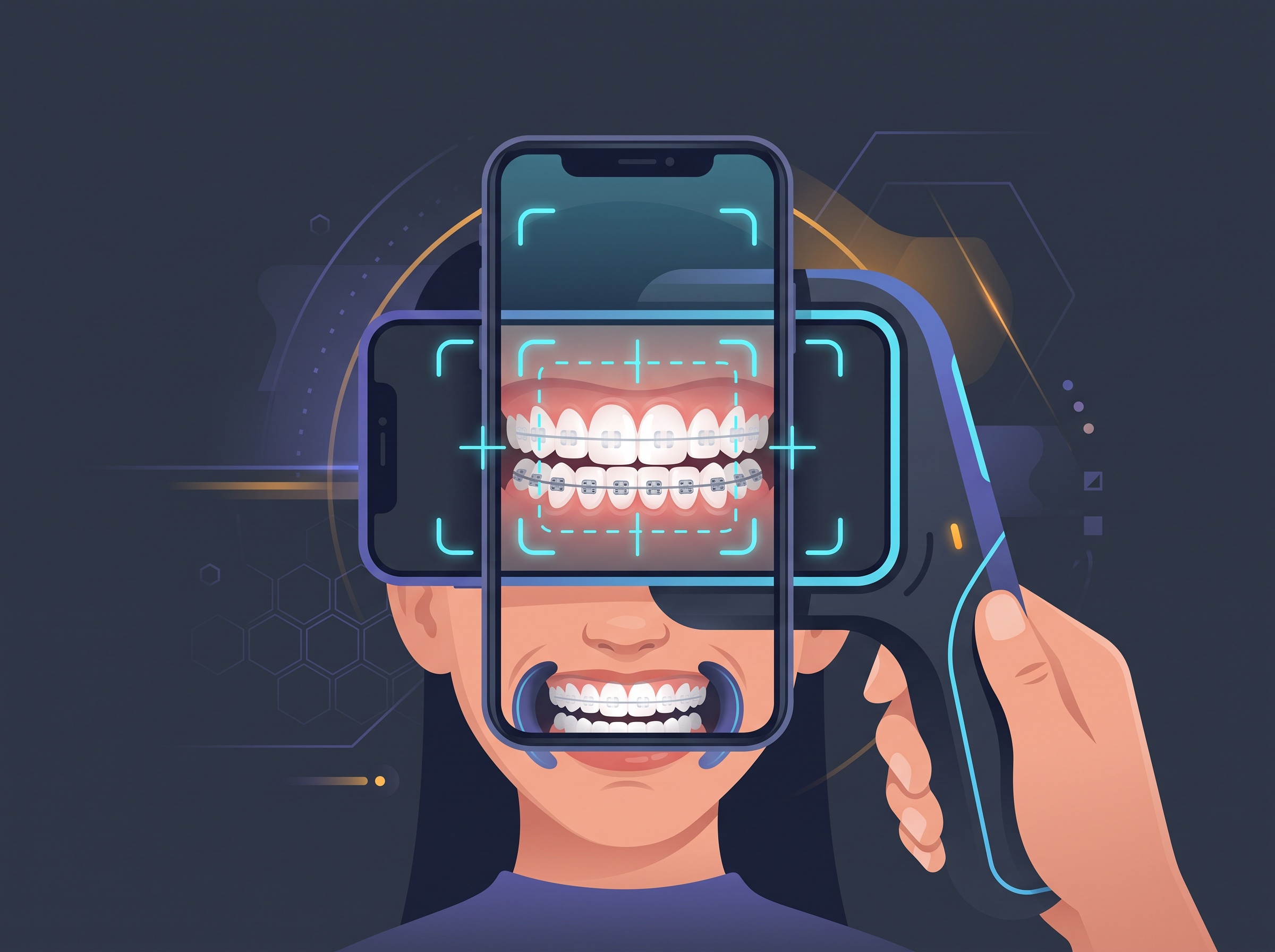
The clever bit of hardware is the ScanBox — a small cheek-retractor device that your phone snaps into. You pull it up to your mouth, it holds your lips out of the way and frames the shot, and the app walks you through capturing your teeth from several angles. It takes a couple of minutes.
Why the gadget matters: consistency. If you just snapped selfies of your teeth, every photo would be a different distance, angle and lighting — useless for spotting small week-to-week changes. The ScanBox forces every scan into the same framing, so the AI is genuinely comparing like with like. That’s the difference between “a photo of your teeth” and “a measurable data point.”
What the AI is looking for
This is where it gets specific. The system isn’t just checking whether your smile looks nice — it’s watching for the concrete things that go wrong or right during treatment. For braces, that’s whether the archwire is sitting passively, whether a bracket has come loose (debonded), whether a tie or clip has failed. For aligners, it’s the big one every aligner patient worries about: seating — whether your tray is fully hugging the teeth or lifting off, which is the usual reason a case stalls.
It also tracks tooth-movement milestones an orthodontist cares about — midline alignment, overbite and open bite, overjet, space closure, even the little “black triangles” that can appear between teeth. When the AI sees one of these, it doesn’t quietly file it away; it surfaces it so a human can decide whether you need to come in, keep going, or move to your next aligner.
Why the FDA milestone is a big deal
Here’s the part that sets DentalMonitoring apart from the pack. In May 2024 it received a De Novo authorization from the U.S. FDA — a first-of-its-kind clearance for AI-driven orthodontic monitoring. De Novo is the pathway the FDA uses when a device is genuinely novel and there’s nothing existing to compare it to, so this wasn’t a me-too clearance; it was the regulator writing a new category.
Concretely, a set of the platform’s indications — 21 of them — are now cleared as medical-device functions under FDA (and equivalent European MDR) rules. That list includes things like archwire and auxiliary passivity, bracket debonding, aligner seat and unseat, retainer seat and unseat, button or attachment loss, midline deviation, overbite, open bite and overjet. Translation: for those specific checks, the AI’s assessment has been formally validated, not just marketed. That’s rare in dental AI and worth knowing if you’re weighing whether to trust a home scan over an in-person look.
What it means for you as a patient
The honest payoff is fewer trips. Orthodontic treatment is a long grind of routine check-ups, most of which end with “all good.” Remote monitoring is designed to skip the ones that don’t need to happen — the company points to studies showing office visits cut by roughly 45% — while increasing how often your teeth are actually looked at, because a weekly scan beats a monthly glance.
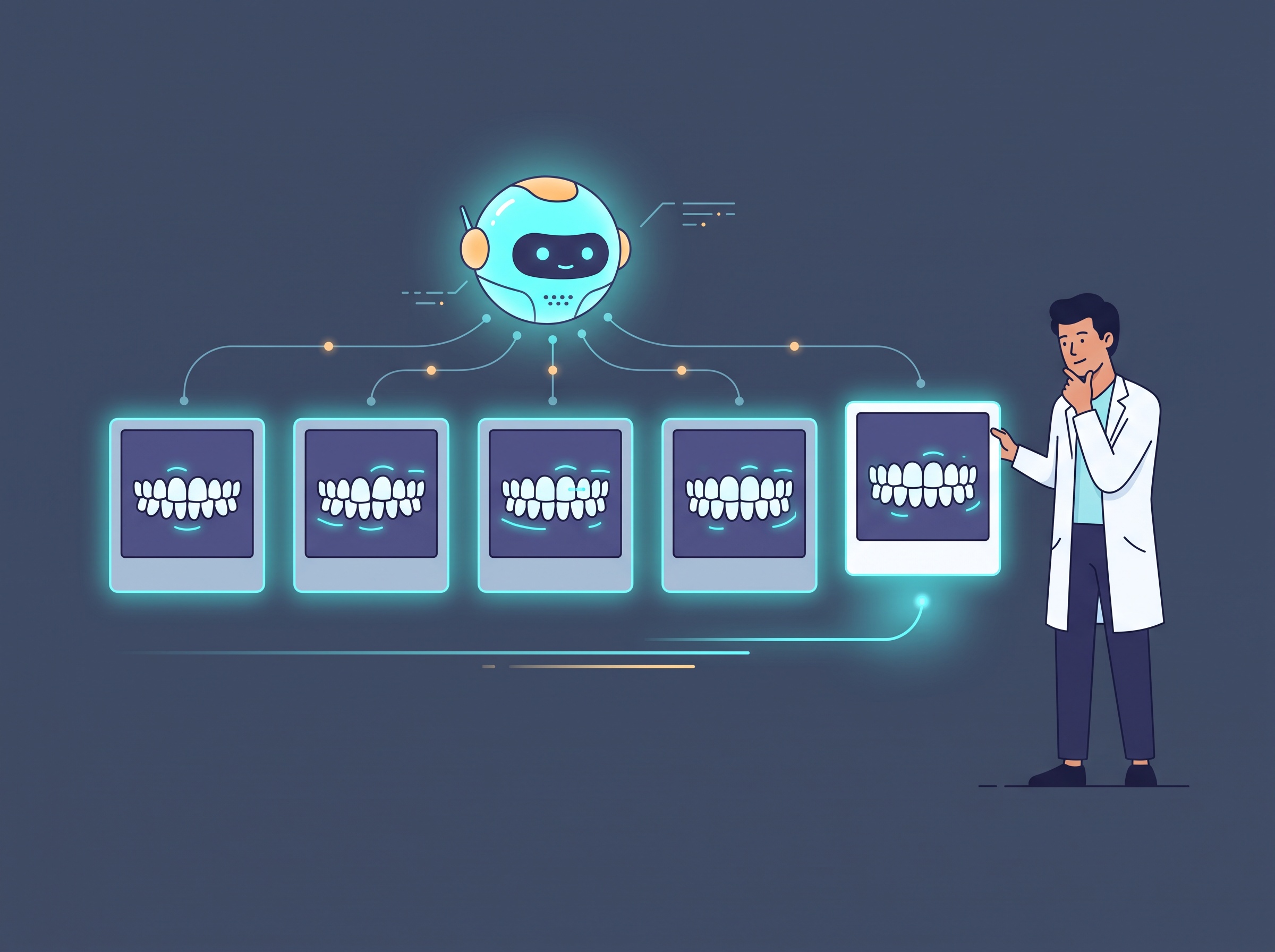
There are real upsides beyond convenience. Problems get caught sooner: a lifting aligner or a broken bracket that might otherwise wait until your next appointment gets flagged within days. And crucially, a licensed orthodontist stays in the loop — the AI does the watching and the flagging, but a human reviews and makes the calls. It’s a second set of (tireless) eyes, not a replacement for your doctor.
The trade-off is on you: it only works if you actually do the scans. Skip a week and there’s nothing for the AI to check. It rewards the diligent and quietly punishes the forgetful.
How it fits the bigger AI-in-dentistry picture
DentalMonitoring is a useful reminder that “dental AI” isn’t one thing. Most of the tools we cover are diagnostic — AI that reads a radiograph the office captured and highlights a cavity or a lesion. DentalMonitoring is longitudinal and patient-captured: its input isn’t your dentist’s X-ray machine at all, it’s a photo you took at home, and its job is tracking change over time rather than reading a single image. It lives in its own app-and-cloud loop, separate from the imaging software your dentist uses in the operatory.
That makes it one of the clearest examples of AI moving care out of the chair and into daily life — the same shift happening in home blood-pressure cuffs and continuous glucose monitors, pointed at orthodontics. If you want the full map of who does what in this space, our field guide to AI in dentistry lays it out, and it’s worth reading alongside the imaging tools like VideaHealth and the do-it-all platforms like Denti.AI. The short version for DentalMonitoring: it won’t read your bitewing, but it might save you a dozen car trips — and catch the loose bracket before you even notice it.

Sources & further reading:
- DentalMonitoring — AI-powered remote monitoring for orthodontics
- DentalMonitoring Achieves Historic FDA Approval for AI Orthodontic Monitoring Software — Dentistry Today
- DentalMonitoring Software Major Update Includes FDA-Validated AI-Driven Clinical Indications — BusinessWire
- DentalMonitoring Review (2026): Pricing, Features & Rating — The Molar Report
Related Reading
- The State of AI in Dentistry 2026: A Field Guide to the Tools
- Denti.AI: Voice-Enabled Charting, Perio, and the AI Scribe
- VideaHealth: The AI That Charts Your Teeth Automatically