Pearl Second Opinion: Chairside AI That Reads Your X-rays

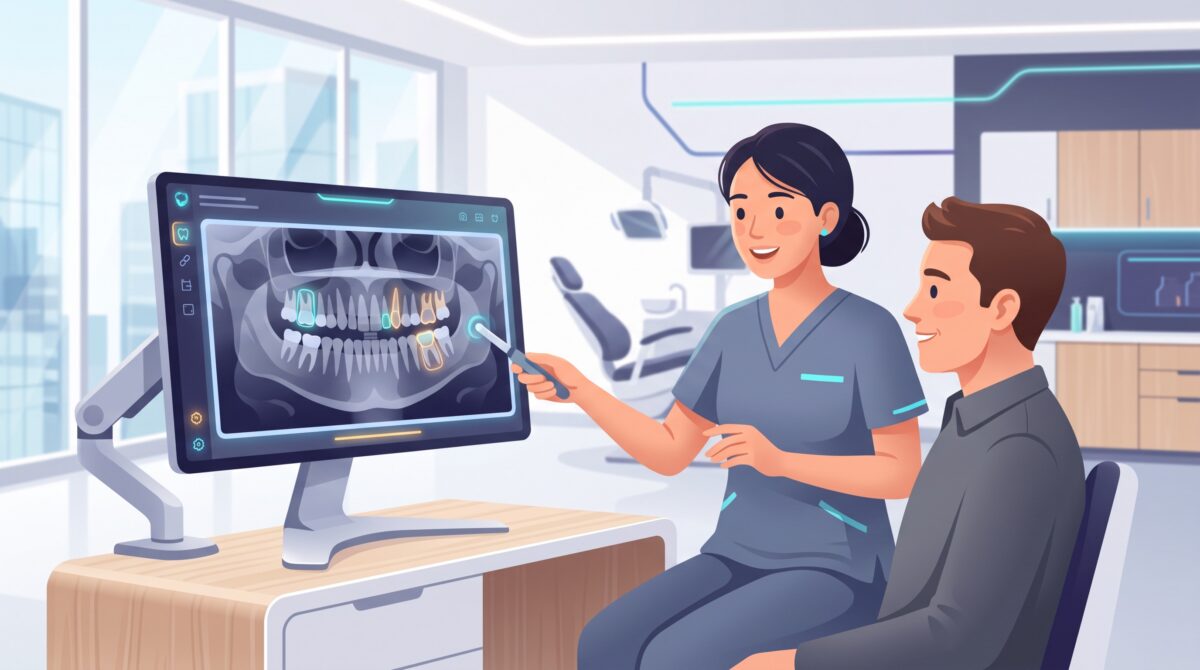
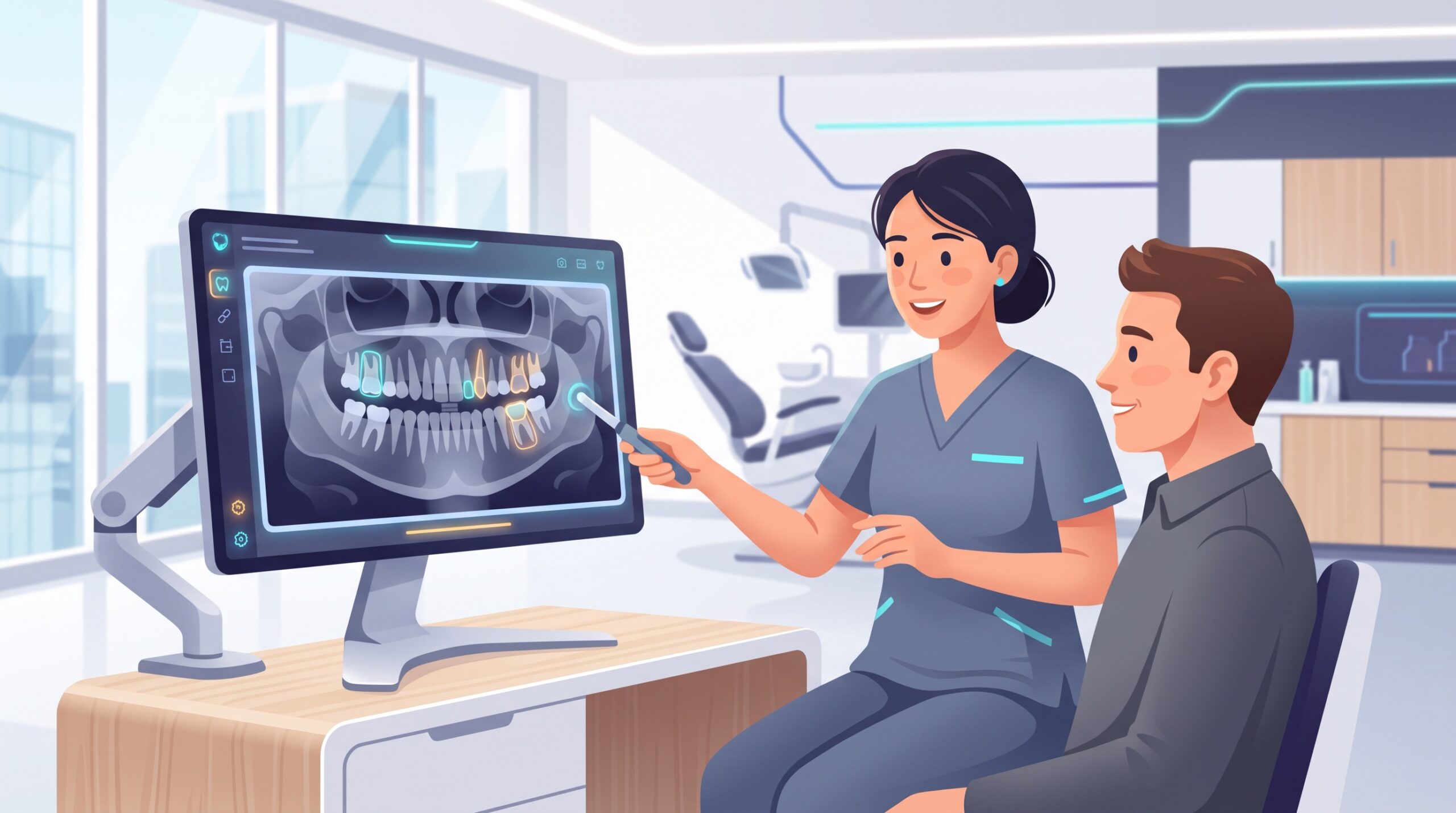
You know the moment. The dentist swivels the monitor toward you, points at a grey smudge on a black-and-white X-ray, and says the word “cavity.” You nod, because what else are you going to do – you can’t actually see it. The image might as well be a weather map. Pearl’s Second Opinion is an AI built to fix exactly that moment: it reads the X-ray the instant it is taken and draws a colored outline around what it finds, so the thing the dentist is talking about is finally something you can see too. It is one of the most visible examples of AI quietly moving into everyday dentistry, and it is worth understanding before it is on the screen in front of you.
What Second Opinion actually does
Second Opinion is computer-vision AI trained on a huge library of dental radiographs. When a new X-ray is captured, the software scans it for the things dentists look for and highlights them: suspected tooth decay (caries), calculus (hardened tartar), and bone loss around the teeth that can signal gum disease. Newer versions also measure how much bone is present in millimeters and flag findings like periapical radiolucencies – the dark spots near a root tip that can mean infection.
The key word is assist. Pearl’s tool does not diagnose you and it does not decide your treatment. It is a second set of eyes that never gets tired, never rushes because the schedule is running late, and looks at every image the same careful way. Your dentist still makes the call. If you want the wider map of where tools like this fit, our field guide to AI in dentistry lays out the whole landscape.
How it shows up at your appointment
Here is the part that surprises people: you probably won’t even notice it happening. Second Opinion is designed to run inside the imaging software your dentist already uses. The X-ray gets taken exactly the way it always has, the image is sent off for analysis in the cloud, and it comes back with the highlights already drawn – usually in a few seconds, before you’ve even settled back into the chair.
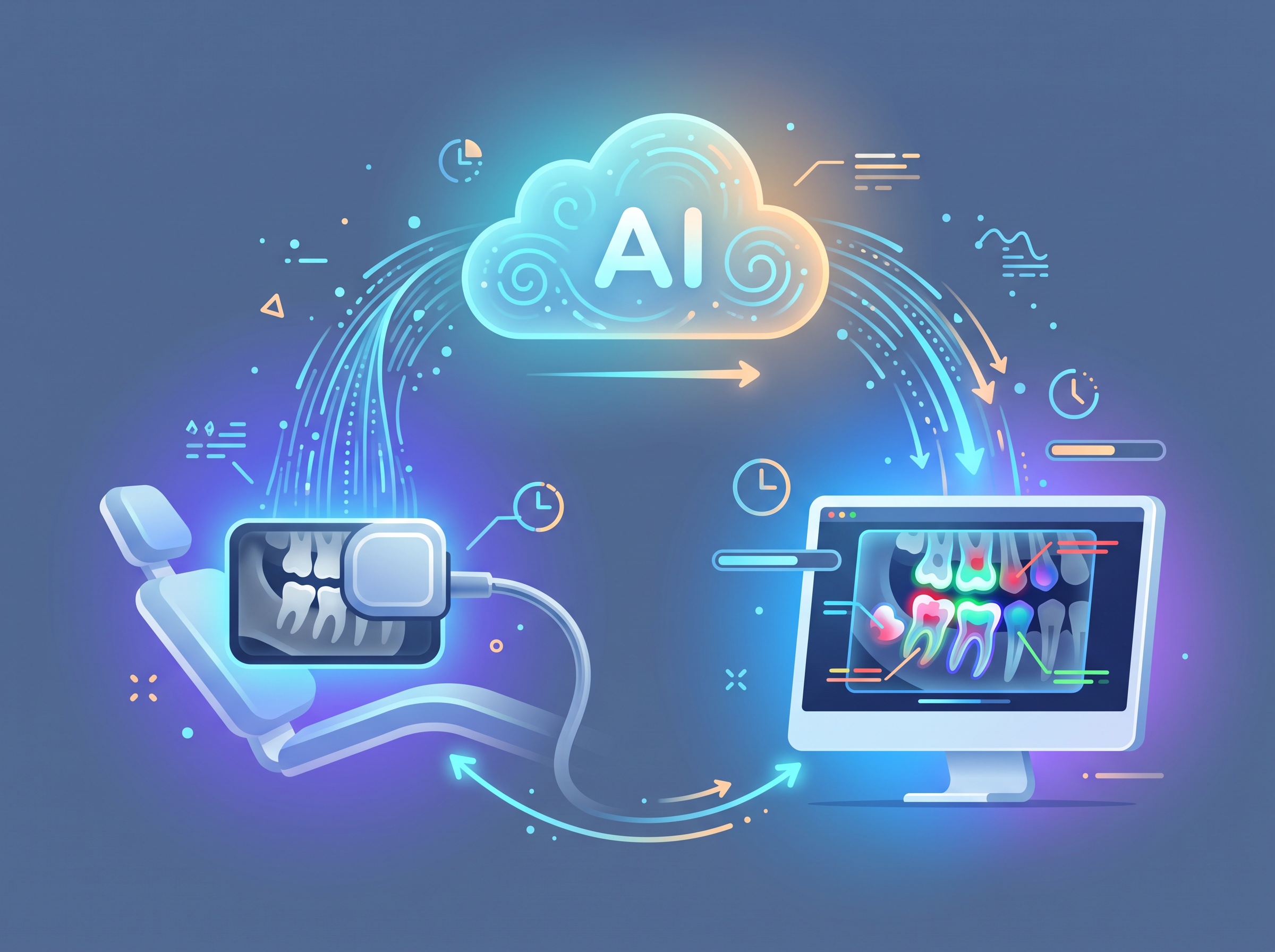
There is no special scan, no extra radiation, and nothing different you have to do as a patient. The AI is working off the same X-ray your dentist was going to take anyway. What changes is what appears on the screen afterward: instead of a plain grey image, you get one with the areas of concern circled and color-coded, ready to talk through.
What the FDA clearances mean
Pearl is unusual in how seriously it has taken regulators. Second Opinion is cleared by the U.S. Food and Drug Administration through the 510(k) process, and in 2025 Pearl announced it had become the first dental AI company cleared by the FDA for both 2D and 3D imaging – meaning it can read not just flat bitewing X-rays but also 3D CBCT scans. Separate clearances have since covered automated bone-level measurement, pediatric patients, and, in late 2025, panoramic X-rays (the wide single image that captures your whole jaw).
So what does “FDA cleared” actually mean for you? It means the software was reviewed as a medical device and shown to perform comparably to an accepted standard on a specific, defined task – not that it is flawless, and not that it replaces a human. It is a genuine bar that a lot of “AI” products never clear. Treat it as a real credential, but not as a promise of perfection. If a claim stretches past “it helps the dentist,” it is marketing.
Why seeing it changes the conversation
The sleeper benefit of a tool like this isn’t accuracy – it’s clarity. For decades the dentist-patient conversation about an X-ray has been a trust exercise: they see something, they describe it, and you take their word for it. That dynamic breeds suspicion, which is exactly why “is my dentist overselling this?” is such a common worry.
When the suspected cavity is outlined in color on your own image, the conversation shifts from “trust me” to “look here.” You can see the flagged spot, ask why it’s flagged, and make a genuinely informed decision. It cuts both ways, too – the AI can just as easily show a clean image, which is reassurance you can actually look at. For the practice side of that story, our sister explainer on Overjet digs into how the same kind of imaging AI plays into insurance claims.
The honest limits
None of this makes the AI infallible, and pretending otherwise does you a disservice. Computer vision can flag something that turns out to be nothing (a false positive) or occasionally miss something (a false negative). The quality of the underlying X-ray matters enormously – a blurry or poorly angled image gives the AI less to work with, just as it gives a human less. And the tool only sees what is on the radiograph; plenty of dentistry depends on things an X-ray never captures.
That is why “second opinion” is the honest name for it. It is a prompt for a conversation, a prompt for your dentist to take a closer look, and a way to make the invisible visible. It is not a verdict, and any good clinician will treat it the same way.
The takeaway for patients
If your dentist starts showing you X-rays with neat colored outlines on them, you are looking at chairside AI, quite possibly Pearl’s Second Opinion. It is a good thing to see – not because it is magic, but because it drags a historically opaque part of your care into the open where you can actually participate. The best use of AI here isn’t replacing the expert in the room; it’s giving you and that expert the same clear picture to look at. Next time the monitor swivels your way, you won’t just be nodding along – you’ll be able to see what they see, and that is the whole point.
Sources & further reading:
- Pearl Becomes First Dental AI Company Cleared by FDA for Both 2D and 3D Imaging – Pearl
- Pearl Expands Dental AI Capabilities with FDA Clearance for Panoramic X-Rays – Pearl
- Pearl’s Second Opinion expanded capabilities get FDA nod – DrBicuspid.com
Related Reading
- Overjet, Explained: What Dental AI’s Insurance-and-Imaging Platform Actually Does
- The State of AI in Dentistry 2026: A Field Guide to the Tools
- Diagnocat: Cloud AI for 2D X-rays and 3D CBCT