Coding Agents That Work While You Step Away: What Factory’s ‘Droids’ Actually Do


Picture this: you kick off a task — “add pagination to the reports endpoint and write the tests” — then close the laptop and go to lunch. When you come back, there’s a pull request waiting. The code is written, the tests pass, the description explains what changed. You didn’t babysit a chat window. You just reviewed the result.
That’s the promise behind a fast-growing class of developer tool: the autonomous coding agent. The most talked-about example right now is Factory, whose agents are called droids. They’re a good lens for understanding what this whole category actually does — and, just as important, what it doesn’t.

This isn’t autocomplete anymore
For a few years, “AI in your editor” meant smart autocomplete: you type, it suggests the rest of the line or function. Useful, but you’re still the one driving every keystroke.
An autonomous agent flips the relationship. Instead of finishing your line, it takes ownership of a task. According to Factory’s own description, a droid can “pick up a task, write the code, run the test suite, open and review a pull request, update documentation and carry the change toward deployment.” In other words, it does the loop a junior engineer would do — not the single next token.
The key word is asynchronous. You don’t have to sit there watching. You hand off the work and go do something else, the same way a tool like Perplexity’s “Teammates” run tasks in the background while you’re away. The agent reports back when it’s done or stuck.
What a droid actually does, step by step
Strip away the branding and the workflow is refreshingly concrete:
- It reads the whole repo, not just your open file. Factory calls this agentic search — the droid figures out the relevant context across the codebase instead of making you paste in the right files.
- It plans before it types. Good agents decompose the task into steps first, so they’re not improvising one edit at a time.
- It makes coordinated changes. Factory claims droids can touch “hundreds of files” in one change — the kind of sweeping rename or refactor that’s tedious and error-prone by hand.
- It runs the tests and opens a PR. The output isn’t a wall of chat text. It’s a pull request you can review, comment on, and merge like any other.
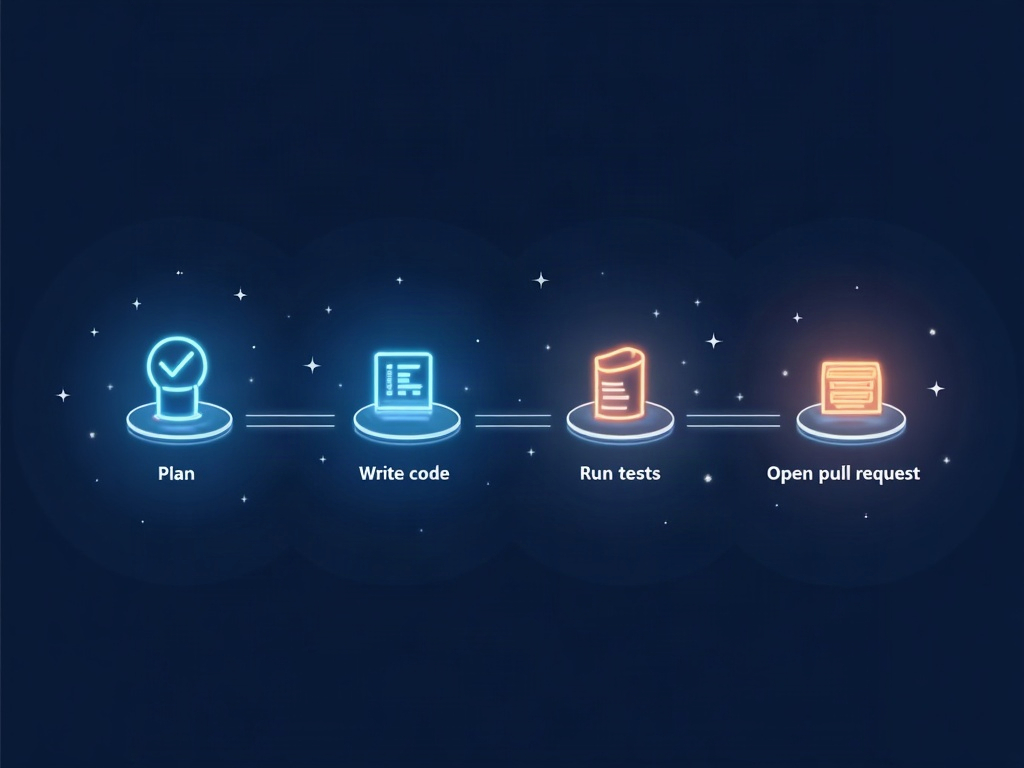
You also get a dial for how much leash to give it. Factory lets you “fine-tune how independently your agent operates,” from suggest-and-confirm all the way to run-it-yourself. That dial matters — more on that below.
“Missions”: parallel work that runs for hours
The genuinely new idea is scale. Factory 2.0 introduced Missions — described as “multi-agent autonomous execution” that solves complex tasks “over hours or days by decomposing work into parallel tracks.”
Instead of one agent plodding through a big job, the work is split into lanes and several droids run at once, each on its own track, sharing context. Think of a migration that touches the database layer, the API, and the front end: three strands that can largely proceed in parallel and then converge. It’s the difference between one assistant and a small, coordinated crew.

Where they actually pay off — and where they don’t
Here’s the honest part. Autonomous agents shine on work that is well-specified and verifiable:
- Mechanical refactors and large renames across many files.
- Writing tests for existing code, or raising coverage.
- Dependency bumps and framework migrations with a clear target.
- Boilerplate: new endpoints, CRUD, scaffolding that follows an existing pattern.
They struggle — and will happily produce confident, wrong code — on work that’s ambiguous, requires product judgment, or depends on context that lives in someone’s head rather than the repo. If you can’t crisply say what “done” looks like, the agent can’t either. And an agent that’s been handed too much autonomy without guardrails is exactly how you get the kind of runaway behavior we covered in the Grok agent that ignored its stop button. Scope tightly, and keep the off switch in reach.
The bottleneck moves to review
There’s a counterintuitive catch worth internalizing before you get excited. As one hands-on review of Factory’s droids put it: “Three droids producing PRs in parallel outruns a two-person review queue fast.”
When writing code stops being the slow part, reviewing it becomes the new bottleneck. A pile of plausible-looking pull requests is a liability if nobody has the bandwidth to actually read them. The teams that win with agents aren’t the ones that generate the most PRs — they’re the ones that keep a disciplined human review gate and only merge what they understand.

That same review mentions pricing is shifting too — from per-seat subscriptions toward task- or compute-based billing. Translation: these agents bill for work done, so a sloppy, over-eager setup can cost you in both review time and dollars.
How to start without getting burned
If you want to try an autonomous agent this week, do it like this:
- Pick a boring, verifiable first task. Add tests to a module, or do a mechanical rename. Something where “right” is obvious and the blast radius is small.
- Start on the tightest leash. Run in suggest-and-review mode before you ever let it act on its own. Earn the autonomy; don’t grant it on day one.
- Insist on a PR, not a merge. Let the agent open the pull request. You merge. Never wire an agent straight to your main branch.
- Read every line it ships. Treat its output like a new contributor’s — helpful, fast, and in need of review. Your judgment is the product now.
- Don’t bet everything on one tool. The agent landscape is moving weekly. A sensible multi-tool AI stack keeps you flexible instead of locked in.
And set expectations honestly. For all the hype, plenty of ambitious agent demos still outrun real-world adoption — we looked at that gap in where AI agents actually pay off today. The wins are real, but they’re specific.

The takeaway
Autonomous coding agents won’t replace the thinking part of software — the deciding what to build, and the judging whether it’s any good. What they genuinely change is the drudgery: the refactors, the tests, the migrations, the hundred-file edits nobody enjoys. Handed a well-scoped task and kept on a sensible leash, a droid can do that work while you step away and focus on the problems that actually need a human. That’s the whole game with AI tools worth using — not replacing you, but clearing the busywork so your attention lands where it matters.
Sources & further reading:
- Factory 2.0: From coding agents to software factories (Factory)
- Factory Droids | AI Coding Agents (Factory)
- Cognition’s Devin Rival 2026: Factory Droids Tested (AI Learning Guides)
Related Reading
- Your Phone Is About to Do Your Chores: What Android’s New AI Agents Actually Do
- AI Agents Are Finally Going Mainstream: Your Personal Productivity Revolution Starts Now
- Cursor 3: The AI Coding Revolution That Puts All Your Agents in One Place