Thinking of an AI Toy for Your Kid This Holiday Season? Read This First

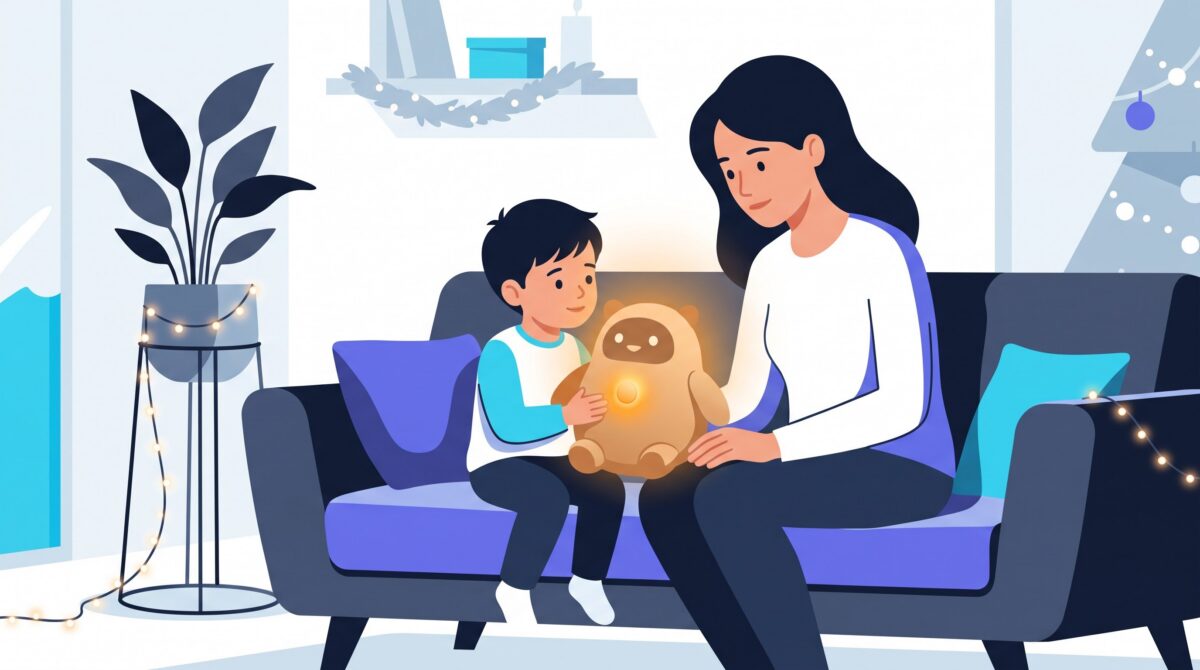
Walk through any toy aisle this December and you will meet a new kind of gift: the plush bear that chats back, the doll that remembers your kid’s name, the little robot that answers questions in a friendly voice. They are marketed as magical. They are also, according to a growing pile of research and a brand-new state law, among the most scrutinized toys of the year.
If an AI toy is on your shopping list, here is the honest, practical rundown before you tap “buy.”
What an “AI toy” actually is
Strip away the fur and the big plastic eyes, and an AI chatbot toy is three things working together: a microphone, a speaker, and an internet connection to a large language model running on someone else’s servers. Your child talks, the toy streams that audio to the cloud, an AI generates a reply, and the toy speaks it back. That round trip is what makes it feel alive.
It is also what makes it fundamentally different from a talking toy from ten years ago. The old ones played a fixed library of recorded phrases. These generate brand-new responses on the fly, which means no one, including the manufacturer, can fully predict what the toy will say next. That unpredictability is the whole problem.
What the safety testing actually found
This is not hand-wringing from technophobes. In late November 2026, a coalition of 155 child-advocacy groups and experts sent an open letter urging Amazon and eBay to pull AI toys from sale until they are proven safe, warning of exposure to sexual content, surveillance of children’s conversations, and kids becoming emotionally dependent on the devices, as The Guardian reported.
Consumer-watchdog testing backed up the alarm. Researchers found that many of the toys they examined were, in plain terms, still too faulty to be on the market: some gave inappropriate answers to children’s questions, and many had serious privacy weaknesses, including recording conversations or taking pictures unexpectedly. Common Sense Media, which ran its own evaluations, concluded the toys simply are not safe for kids yet, and its founder told parents not to wait for regulators and to stick with traditional toys this holiday season.
New York just hit pause, but not before Christmas
On November 24, 2026, New York Governor Kathy Hochul signed a bill establishing a five-year moratorium on manufacturing, distributing, or selling AI chatbot toys in the state, covering talking stuffed animals, dolls, and robots with embedded or integrated chatbots. It is the first law of its kind in the United States.
Two details matter for shoppers. First, the ban does not take effect until February 2027, so the toys will still be on shelves and in online carts all through this holiday season, in New York and everywhere else. Second, a state ban is a loud signal, not a guarantee. If lawmakers felt the need to freeze an entire product category for five years, that tells you how the risk is being weighed by people who have seen the testing data.
The microphone-in-the-playroom problem
Even a toy that never says anything inappropriate still carries a privacy cost that is easy to overlook: it is an always-listening microphone in the room where your child plays, sleeps, and talks freely. Those recordings have to go somewhere, and “somewhere” is a company’s database.
That is not a hypothetical. Earlier in 2026, security researchers discovered that one AI toy had left more than 50,000 children’s chat transcripts exposed on a web-accessible console, as documented by Proton. It is the same lesson that keeps surfacing across every corner of AI: the data you hand over rarely stays as private as you assume. We have written before about how even ordinary AI chat transcripts can end up indexed on Google, and about how much AI assistants can quietly see when you let them listen and watch. A toy raises the stakes because the person speaking is a six-year-old who has no idea any of this is happening.
If you are still considering one, run this checklist
Some families will decide the fun is worth it, and that is a reasonable call to make with eyes open. If you go ahead, work through these questions first:
- Where does the audio go, and for how long? Find the privacy policy. If you cannot tell whether recordings are stored, for how long, or whether they are used to train AI, treat that as a no.
- Is there a real off switch and a mute? You want a physical control that genuinely cuts the microphone, not a setting buried in an app.
- Does it have parental controls and conversation logs you can review? If you cannot see what your child and the toy actually said to each other, you have no way to catch a problem.
- Who made it, and will they still exist next year? Many of these toys come from small startups. If the company folds, the “smart” toy can stop working and your data may be sold or orphaned.
- Can you keep it on a leash? The same lesson from grown-up AI applies here: autonomous systems that ignore a stop command are a known failure mode, which is exactly why keeping a clear leash on any AI tool matters even more when a child is on the other end.
The safer play this year
Here is the uncomfortable truth the researchers keep landing on: the technology is moving faster than the safety work, and kids are the test group. You do not have to opt your family into that trial to give a great gift. Blocks, books, art supplies, board games, and a plain old teddy bear still do the one thing these toys were supposed to improve on, sparking a child’s own imagination, without a microphone or a cloud account attached.
AI can be genuinely useful, and we spend most of our time here showing how to make it work for you. But the smartest move with a new technology is knowing when to wait for it to grow up. This holiday season, with an AI toy for a small child, waiting is the power move, and your kid will not miss what they never knew the box could do.
Sources & further reading:
- As Consumers Begin Their Holiday Shopping Season, Governor Hochul Signs Five-Year Ban on AI Chatbot Toys
- Child safety groups urge Amazon and eBay to stop selling AI toys until proved safe (The Guardian)
- Want to buy your kid an AI toy this Christmas? Not in New York (TechCrunch)
- Are AI toys safe? A major breach raises concerns for children’s privacy (Proton)
Related Reading
- 6 AI Gadgets That Actually Make a Home Office Smarter (And Who Each One Is For)
- 10 Game-Changing AI Productivity Tools Everyone Should Know in 2026
- AI Automation Tools That Are Changing How We Work in 2026