Your AI Coding Assistant Could Cost More Than You Do: How to Keep the Bill Under Control


Here’s an uncomfortable number for anyone leaning hard on AI to write code: by 2028, the cost of your AI coding tools could overtake the average developer’s salary. That’s the headline from a Gartner forecast that landed earlier this year, and it’s not a scare story — it’s a warning about how a particular kind of pricing behaves when you’re not watching it.
The good news is that runaway AI coding bills are almost entirely preventable. The cost doesn’t climb because the tools are evil; it climbs because pay-per-use pricing rewards sloppy habits. Tighten the habits and the bill comes back to earth. Here’s what’s actually driving the numbers, what real teams are paying today, and the concrete steps that keep an AI coding assistant fast and cheap at the same time.

Why the bill climbs so fast
The short version: most AI coding assistants are moving from a flat per-seat subscription to consumption-based pricing — you pay for the tokens the model reads and writes. Gartner’s senior principal analyst Nitish Tyagi tied the 2028 projection directly to “rising LLM token consumption and the shift to consumption-based licensing models.”
Tokens are the real meter. Every time an agent re-reads your whole repository, pulls in long files for context, retries a failed run, or churns through a multi-step task autonomously, it spends tokens — and an “agentic” assistant that works on its own can burn through them in minutes without you touching the keyboard. As The Register reported, Gartner also points to vendor opacity as a core problem: many providers give little visibility into how token consumption is calculated and billed, which makes the spend genuinely hard to forecast.
Two caveats keep this honest. First, the “exceeds salary” line is pegged to a global average salary of roughly $2,000 a month, so it bites hardest where developer pay is lower — it doesn’t mean tokens will outrun a senior engineer’s salary in a high-cost market. Second, Gartner isn’t telling anyone to abandon AI. Tyagi’s own view: “You should not move away from AI because the total costs are increasing.” The point is to manage it, not fear it.

What teams are actually spending now
This isn’t theoretical. According to Gartner Peer Insights data cited in the coverage, the spread is already wide:
- 23% of tech leaders report spending $200–$500 per developer, per month on AI coding tokens.
- 6% of organizations already pay more than $2,000 per developer, per month — i.e. above that global average-salary line today.
- Because tool costs don’t vary by geography the way salaries do, the same token bill lands very differently in different markets.
In other words, a meaningful slice of teams have already crossed into the zone Gartner is warning everyone else about. The difference between the teams paying $50 a month and the teams paying $2,000 usually isn’t the tool — it’s the discipline around it. (CIO’s write-up has more on how token costs are tracking against payroll.)
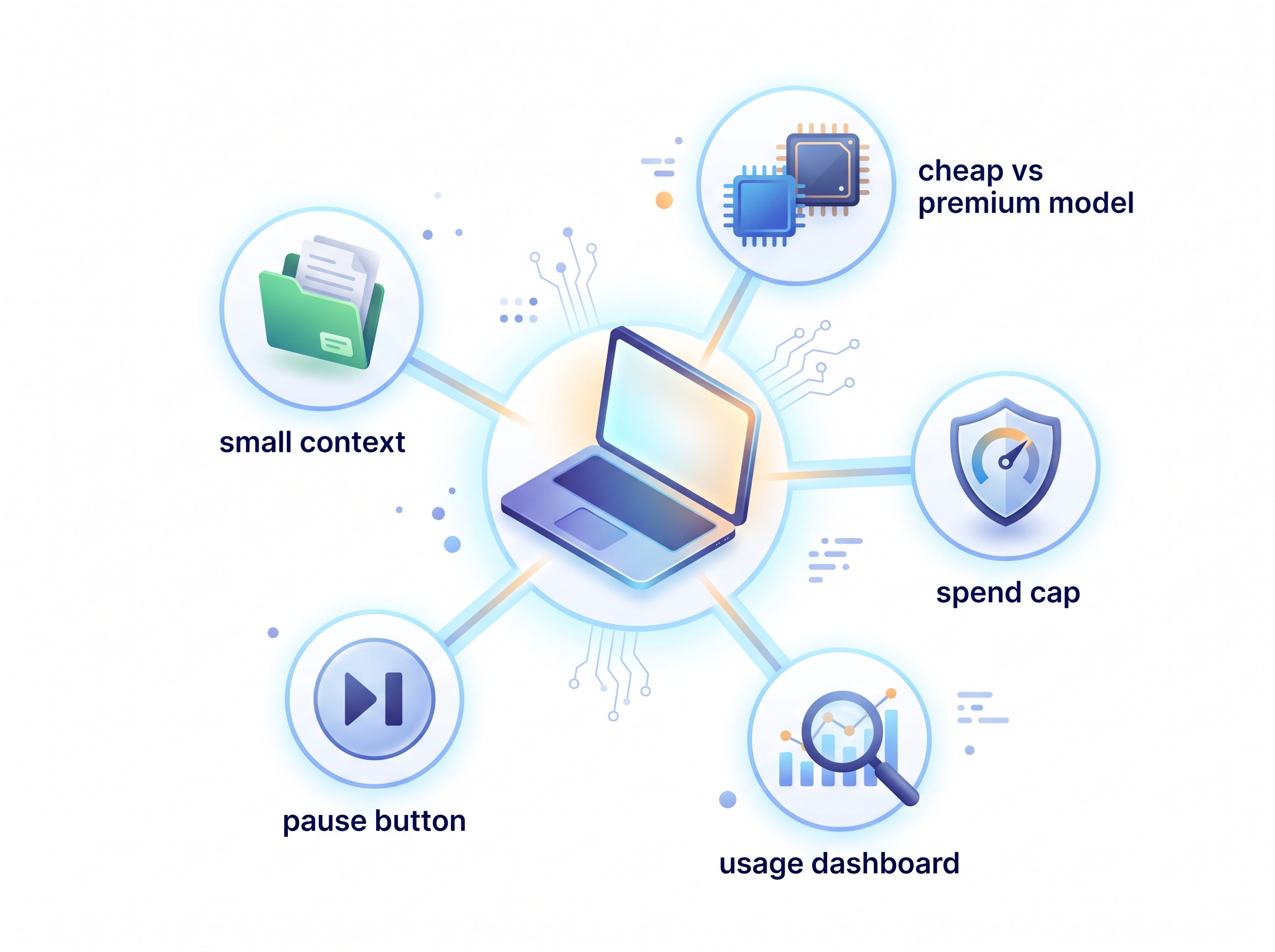
Five habits that keep the bill under control
You don’t need a procurement overhaul. Most of the savings come from five everyday habits:
- Feed it less context. The single biggest token sink is stuffing an entire codebase into the prompt “just in case.” Point the assistant at the specific files or folders that matter. A tight, relevant context window is cheaper and usually gives a better answer, because the model isn’t distracted by irrelevant code.
- Right-size the model. Not every task deserves the biggest, priciest model. Autocomplete, renaming, and boilerplate run fine on a cheaper, faster model; save the flagship for genuinely hard reasoning. Picking the model to fit the job is the highest-leverage knob you have — we broke down exactly how to choose in why the cheap, fast AI model is often the smarter pick.
- Set hard spend caps. Most platforms let you set per-developer or per-project budget limits and alerts. Turn them on before you need them. A cap that pauses an agent at a threshold is the difference between a $40 overage and a $4,000 one when something loops.
- Watch an actual usage dashboard. Vendor opacity is real, so use whatever reporting you do get. Check token spend weekly, not when the invoice arrives. A rising trend line is easy to fix in week one and painful to fix in month three.
- Know when to switch the agent off. Autonomous, multi-step agents are the most expensive mode by far. For small, well-defined edits, a single targeted prompt (or plain old typing) is cheaper and often faster than turning a self-driving agent loose on the repo.

Choose pricing with your eyes open
When you pick or renew a tool, treat the billing model as a feature, not fine print:
- Flat per-seat pricing is predictable — you know the number up front. It can be more expensive for light users, but it never surprises you.
- Usage-based pricing can be cheaper for occasional use and brutal for heavy, agent-driven work. If you go this route, insist on transparency: how are tokens counted, what triggers extra consumption, and can you see it in near-real time?
- Bring-your-own-key setups let you plug in your own model API and watch spend directly on the provider’s dashboard — more control, a bit more setup.
The thread running through all of it is visibility. The teams that get burned aren’t reckless; they’re flying blind on a meter they can’t see. And cost isn’t the only reason to keep a close eye on these tools — security matters too. If you’re handing an assistant access to your codebase, read our guides on stopping your AI coding assistant from leaking your secrets and the wider question of how much developers actually trust AI coding tools.

The bottom line
Gartner’s 2028 forecast is best read as a nudge, not a verdict. AI coding genuinely accelerates real work — that’s why developers adopted it so fast — and nobody serious is suggesting you give that up. What the numbers are really saying is that the era of “set it and forget it” AI tooling is over. Treat tokens like any other cloud bill: cap it, monitor it, right-size it, and feed the model only what it needs. Do that, and your AI coding assistant stays what it’s supposed to be — a force multiplier for your time, not a line item that quietly outgrows the people it was meant to help.
Frequently asked questions
Why are AI coding assistant costs rising so quickly?
Because the pricing is shifting from flat per-seat subscriptions to consumption-based billing, where you pay for the tokens the model reads and writes. Agentic assistants that work autonomously can consume large amounts of tokens quickly, and Gartner notes that limited vendor transparency makes the spend hard to forecast.
Will AI coding really cost more than a developer’s salary?
Gartner projects that by 2028 AI coding costs could exceed the average developer’s salary, but that’s pegged to a global average salary of about $2,000 per month. It bites hardest in lower-wage markets and for heavy, agent-driven usage; it doesn’t mean token costs will outrun a senior engineer’s pay in high-cost regions. Some organizations already pay more than $2,000 per developer per month today.
What’s the single best way to reduce AI coding token costs?
Feed the model less context. Pointing the assistant at the specific files that matter — instead of the whole codebase — cuts token use the most and often improves the answer. Right-sizing the model to the task is a close second.
Should I stop using AI coding tools to save money?
No. Even Gartner’s analyst advises against abandoning AI over rising costs, because the productivity gains are real. The goal is to manage spend with budget caps, usage monitoring, model tiering, and tighter context — not to give up the speed.
Sources & further reading:
- AI coding costs could top developer salaries by 2028 (Gartner) — The Next Web
- AI coding agents could soon cost more than the developers using them — The Register
- AI coding token costs are on track to rival human payroll — CIO
Related Reading
- AI Budgeting Apps That Actually Work: Stop Guessing Where Your Money Goes
- Top AI Coding Assistants in 2026: Beyond GitHub Copilot
- The Best AI Coding Assistants for 2026: A Complete Comparison Guide