AI Is Interviewing You Now: How to Prepare for an AI-Led Job Interview

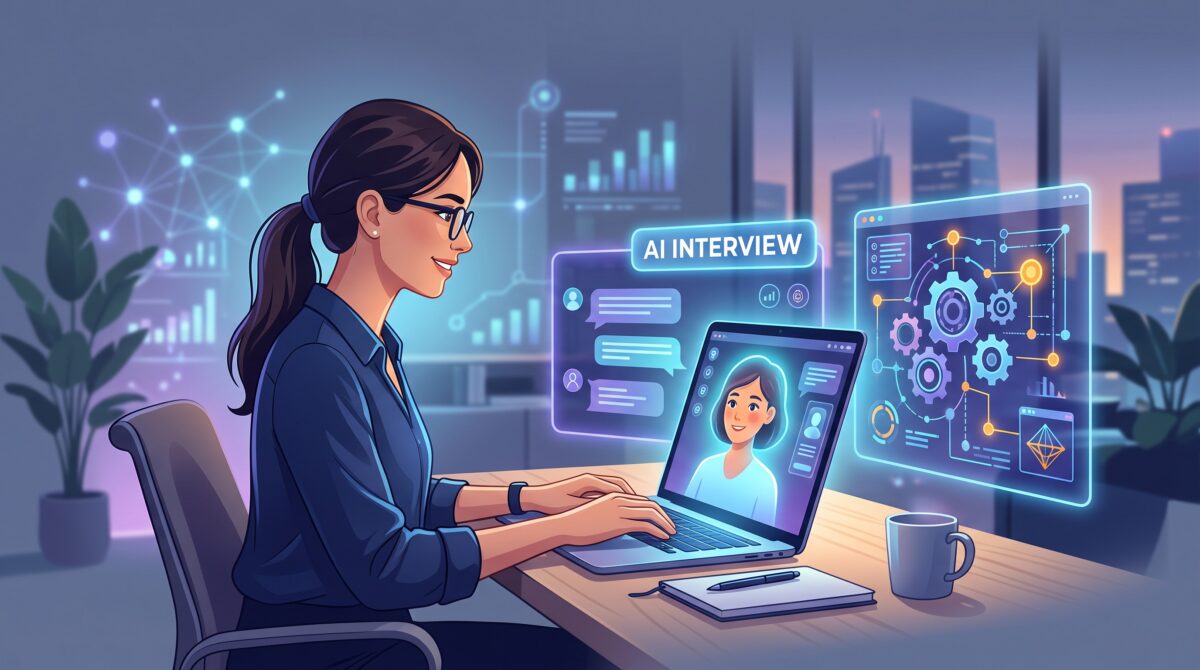
Here’s a sentence that would have sounded like science fiction a couple of years ago: your next job interview might be conducted entirely by an AI. Not a recorded one-way video screen, and not a human reading from a script — an actual AI agent that talks with you, hands you a real problem, and watches how you solve it in real time.
That future just got a lot closer. HackerRank, a platform thousands of companies use to screen technical candidates, has launched Chakra, an agentic AI interviewer that spins up a canvas with a real-world problem, observes how you work through it, and evaluates not just your answer but how you got there. If you’re job hunting — in tech or increasingly beyond it — it’s worth understanding what an AI-led interview actually measures, and how to walk in ready for it.
What’s actually changing
A traditional interview is a snapshot: you give an answer, a human forms an impression, and a lot rides on nerves and small talk. An AI interview is more like a recording of your thinking. Chakra, for example, is designed to observe candidates as they work and judge their reasoning, critical thinking, and — this is the new part — their AI fluency.
HackerRank has described how a technical screen now works: the system can generate follow-up questions based on the exact lines of code you added, the prompts you sent to an AI assistant, and the actions that assistant took on your behalf. In other words, the interview can see you using AI and ask you about the choices you made while doing it. The final answer matters less than the trail you left getting to it.
Why companies are handing the chair to an AI
The appeal for employers is straightforward. An AI interviewer is available at any hour, treats every candidate to the same format, and produces a complete transcript a hiring team can review afterward. That consistency is genuinely good news for candidates who’ve ever lost out to an interviewer’s bad morning or unconscious bias.
There’s a deeper reason, too. Now that nearly every knowledge worker has AI tools on their desk, companies don’t just want to know whether you can write code or a memo from a blank page — they want to know whether you can direct AI well and catch it when it’s wrong. An AI interviewer is simply the most natural way to watch that happen.

What an AI interview evaluates that a human might miss
Because the AI is watching your whole process, the things that move the needle shift. Three qualities stand out:
- Process over polish. A tidy final answer with no visible reasoning is weaker than a slightly messy one where your thinking is clear. The AI is scoring the road, not just the destination.
- Judgment with AI, not avoidance of it. Refusing to touch AI tools can read as a gap, but blindly pasting whatever they produce reads as worse. The sweet spot is using AI to move fast, then catching its mistakes.
- How you recover. When you hit a wall or get a wrong result, what you do next — re-check, reframe, test a smaller case — is often the most revealing signal of all.
How to prepare: five habits that actually help
You don’t need a secret trick. You need to make your good thinking visible. Here’s where to focus:
- Think out loud, on purpose. Narrate your assumptions, your plan, and why you’re choosing one approach over another. An AI interviewer can only credit the reasoning it can observe, so say it.
- Practice driving AI, not just answering. Get comfortable prompting a tool precisely and then steering it. The same skill that helps you get a better AI answer every time is exactly what an AI interview is looking for.
- Always verify what the AI gives you. Build the reflex of checking AI output before you rely on it — a simple habit like a quick fact-check routine to catch AI hallucinations signals the judgment these interviews prize.
- Know your tools cold. Fumbling with an unfamiliar assistant burns time and confidence. If a role involves coding, make sure you can use AI coding tools without over-trusting them long before interview day.
- Rehearse under a clock. AI screens are often timed. Practicing with a timer trains you to state a plan quickly instead of freezing.
During the interview: do’s and don’ts
A few concrete moves can make the difference between a transcript that reads as capable and one that reads as lost:
- Do restate the problem in your own words first. It shows comprehension and buys you a moment to think.
- Do explain why you’re reaching for a particular AI tool or approach, not just that you are.
- Don’t go silent for long stretches. Silence that would be fine with a patient human reads as a blank to a process-scoring AI.
- Don’t paste AI output you can’t explain. If the agent asks “why did you do this?” — and it will — you need an honest answer.
- Do treat a wrong turn calmly. Narrate the fix. Recovery is a feature, not a failure.
Practice with AI before you’re graded by it
The best preparation for being interviewed by an AI is to rehearse with one. HackerRank and others now offer AI-powered mock interviews, including voice-based formats that simulate a recruiter or hiring manager’s screen from end to end. Even a free, general-purpose chatbot can run you through a realistic dry run: ask it to act as an interviewer for the specific role, give you a problem, press you with follow-up questions, and then critique how clearly you explained your reasoning.
Do that two or three times and the real thing stops feeling alien. You’ll have practiced the one skill that matters most here — thinking visibly and steering AI with confidence — in exactly the setting you’ll be judged in.
The bigger picture
It’s easy to find this unsettling, and the concerns about fairness and over-automation in hiring are real and worth watching. But there’s a genuinely hopeful read, too. An interview that rewards clear reasoning and smart use of tools is one that rewards how you actually work — not how smoothly you perform under a stranger’s gaze for 45 minutes.

The AI in the interview chair isn’t there to replace what makes you valuable. It’s there to spot it faster. Your judgment, your ability to ask the right question, and your knack for catching a confident-sounding wrong answer are exactly the human strengths these tools can’t supply on their own. Prepare to show them plainly, and an AI-led interview becomes less a test to fear and more a stage built for precisely what you do best.
Sources & further reading:
Related Reading
- How to Use AI to Spot Scams Before They Get You: A Practical Guide
- How to Use AI Agents to Automate Your Workflow in 2026
- An AI Just Hacked Three Real Companies During a Test — What It Actually Means for You