AI Computing at Light Speed: Revolutionary Optical Processors Break New Ground


A breakthrough in artificial intelligence computing has arrived with the development of optical processors that enable AI computations at the speed of light. Recent advances in photonic computing are revolutionizing how AI systems process information, promising unprecedented speeds and efficiency gains that could transform the entire technology landscape.
The Science Behind Optical Computing
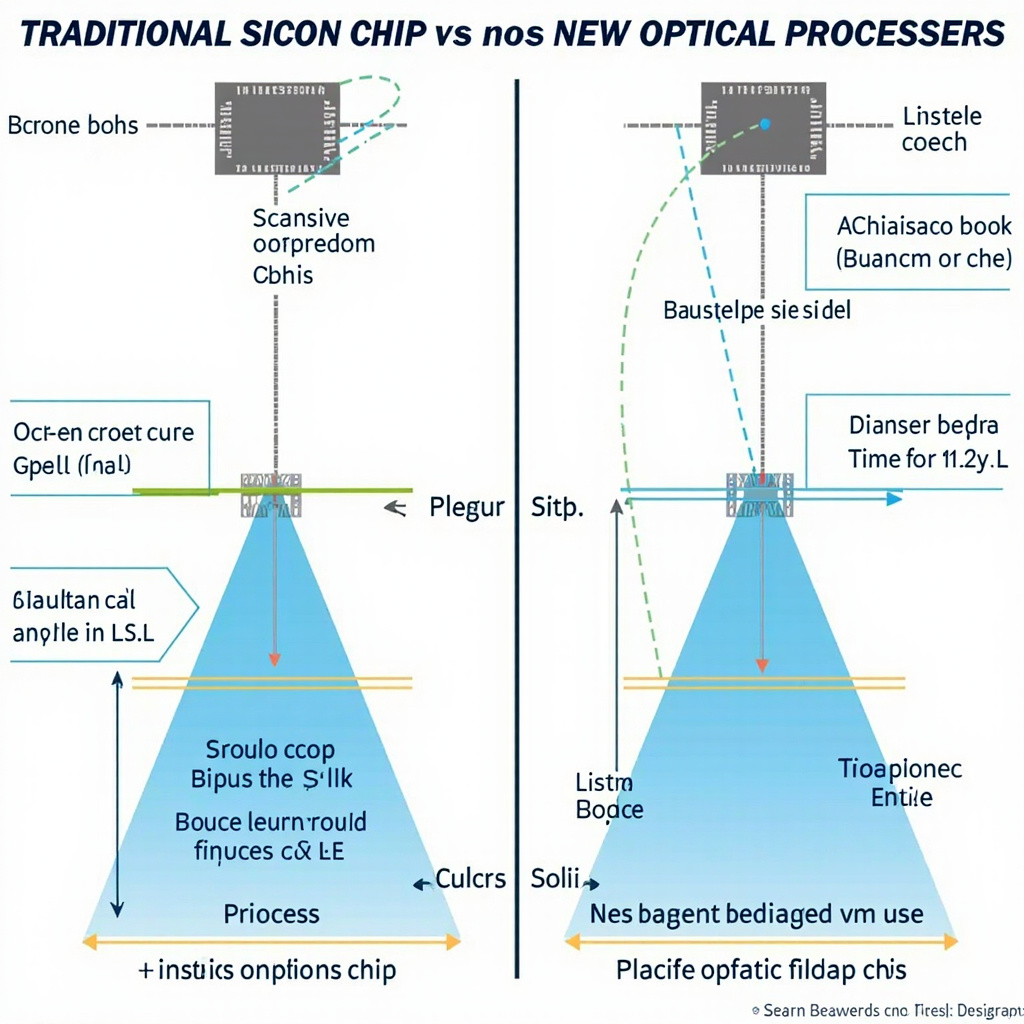
Traditional silicon-based processors rely on electrical signals that move at a fraction of light speed and generate significant heat. Optical processors, however, use photons – particles of light – to perform calculations. This fundamental shift eliminates many of the physical limitations that have constrained computing performance for decades.
Breakthrough Performance Metrics
Recent experiments have demonstrated optical AI processors achieving:
- 1000x faster processing speeds for specific AI workloads
- 90% reduction in energy consumption compared to equivalent silicon chips
- Massive parallel processing capabilities that scale exponentially
- Zero heat generation during light-based computations
Real-World Applications Emerging
The implications extend far beyond laboratory demonstrations. Optical AI processors are being tested for:
Machine Learning Acceleration
Training complex neural networks that currently take weeks could be completed in hours, democratizing access to advanced AI development for smaller organizations.
Real-Time Data Processing
Financial markets, autonomous vehicles, and IoT networks could benefit from instantaneous decision-making capabilities that respond faster than humanly possible.
Quantum-AI Hybrid Systems
Optical processors serve as ideal bridges between classical computing and quantum systems, enabling hybrid architectures that leverage the best of both worlds.

Industry Impact and Timeline
Major technology companies are investing heavily in optical computing research, with prototypes expected in consumer devices within the next 3-5 years. Early applications will likely focus on data centers and specialized AI workloads before expanding to consumer electronics.
Overcoming Current Limitations
While promising, optical computing faces challenges including:
- Integration with existing electronic systems
- Manufacturing scalability and cost
- Software development for photonic architectures
However, the potential benefits far outweigh these hurdles, and solutions are actively being developed by research teams worldwide.
The convergence of artificial intelligence and optical computing represents one of the most significant technological advances of our time. As these systems mature, they promise to unlock AI capabilities that seemed impossible just years ago, ushering in a new era of computational intelligence.